Thursday, January 16, 2014

What to call your characters? Three reliable tips to help you choose.

Are you saddling your characters with the wrong names?  How would you know if you were?

It’s true that a rose by any other name would smell as sweet… as would a Eustace Scrubb or Severus Snape or Winnie the Pooh or India Opal Buloni.  But sometimes, we miss the obvious when we’re picking names for our story characters.  Here are three quick tips for finding character names that will be just as memorable as these.

0763644323(Who’s India Opal Buloni?  Guess you’re going to have to check out Kate diCamillo’s leisurely-paced but mesmerizing Because of Winn-Dixie – our current read-aloud – to find out… and meanwhile, what a name, right?!)

1.  Decide who will stand out.

Many things can make a name stand out – and that’s not a bad thing.  But you as the writer have to decide who stands out and who doesn’t in your story.  A principal who appears as an incidental character in one scene shouldn’t bear the mellifluous moniker “Melville Monofinindohatchee.”  For one thing, you’d take more time introducing him than he’s on stage in the first place.

Many things can make a name stand out:  alliteration (like I just did!), a name that’s Dickensian in its moralism (Ebenezer Scrooge), or a name that’s a little strange and unexpected (Winn-Dixie, or India Opal Buloni).  It’s not a bad thing for a name to stick out from the crowd, but the uniqueness of the name should be related to the significance of the character.

2.  Make it suit your story.

You don’t have to pick a rare, fancy or even unique name.  Remember, the most popular kids’ books of all time revolve around a boy named Harry Potter.  The name you choose doesn’t have to have Dickensian portent if you don’t want it to.  What it does have to do is flow naturally from the style of your story. 

B000VYX8PE0064431789For the elaborate, gothic faux-horror motif that frames the Series of Unfortunate Events books, you may need names like Klaus, Violet and Sunny Baudelaire, but many perfectly wonderful books have been written about characters with everyday names as well. 0394824903 You’ll probably never forget Max from Maurice Sendak’s Where the Wild Things Are, or Marvin, from Dr. Seuss’s Marvin K. Mooney, Will You Please Go Now? (yeah, I know it’s really about Richard Nixon!) even though their names are extremely ordinary – or were ordinary when the book was written…. which reminds me:

Be conscious of the “age” of your name.  These days, Abigail is a common little-girl name.  But when my sister was born 30-something years ago, it really wasn’t, and I barely forgave my parents for choosing it for her.  “You’re giving her an old-lady name!” I yelled at them, in bossy-but-innocent wisdom. 

0064434516They picked the name anyway, and you can too, if you like, but I’m going to yell the same advice to you:  pick a name that suits your character’s age and the period in which they live.  “Frances” was probably a perfectly ordinary girl’s name in 1960, when Russell Hoban’s Bedtime for Frances was written, but these days, it’s a bit dated.  Ignore this advice if you want to – my sister seems to love her name, so there you go.

3.  Pick a name and stick with it.

On a writers’ group in which I participate, someone mentioned that she’d been proofreading a book with a character named Paul, a company vice-president (it was an adult book), who was referred to variously, throughout the book, as:  Paul, Paulie, Paulie-Wallie, Mr. Charleston, Paulie C., Mr. C., Mr. VP, Mr. Veep, the vice president, the veep, and Mr. Marketing.

With few exceptions, you’re only allowed to mix up the names as much as you would in real life, which is to say, not much at all.  You don't call your mother "mom" "moms" "momzy" "mommy" in the space of a single conversation ... unless she has some kind of weird split personality. 

On the other hand, it’s okay for certain characters (not all!) to call your character by different names if it comes naturally as part of their relationship.  If his name is Charlie, maybe his brother calls him Chuck and his mom, "sweetie."  But you shouldn't then have his best buddy call him "Chaz" and his wife call him "Cheetah."  Keep it as natural as possible; listen to the way we speak in real life and you (probably) won't go wrong.

Whether you use a random name generator, spend hours with a Bible or a name dictionary, or just let names bubble up from the depths of your imagination, I’d love to hear how you figure out which character names to stick with and which to toss back into the bin!  Let me know more about your process in the Comments section.

Wednesday, January 15, 2014

Lost in Translation: The Giving Tree

Sheesh!  Some kids’ books translate beautifully into Hebrew, the works of Dr. Seuss surprisingly among them.  But tonight in Hebrew class, I had my first encounter with the Israeli clip_image001version of an old, old favourite, Shel Silverstein’s The Giving Tree (Hebrew version here)… and came away slightly bruised and beaten.

You can read all about it here on my Aliyah (moving-to-Israel) blog because I’m not about to live through it all again by typing the story anew over here, too!

Click here to get the full scoop.

Have you ever read a so-called “translation” of a favourite book that just didn’t click in the other language?  Which book(s) and why???

Tuesday, January 14, 2014

Book Review: How the Moon Regained Her Shape, by Janet Ruth Heller

Moon.phpI’m so excited!  So many people have responded to my request for books to review.  Sadly, some of the books I received weren’t ideal for our family, and I’ve also had a frustrating time downloading a few due to poor bandwidth (don’t ask, but we’re moving soon, which should fix the problem!).

One of the books that we’ve managed to enjoy so far was Janet Ruth Heller’s How the Moon Regained Her Shape (2006:  Sylvan Dell Publishing).

*** A Bit About the Book

Although this is a book “about” bullying and self-esteem, don’t worry – Janet neatly avoids Mistake #1:  Tossing in Values.   The message of the story flows very naturally from the characters and incidents that unfold.

I admit, I’m a bit biased because Janet sent me a private link to the publisher’s website where we could listen to the story and read along in English and Spanish (we only listened to the English).  I don’t know if the reader was Janet herself, but really, it was very well read, with great dramatic effect.

It’s always nice being read to, even at my age. :-)

I listened to and read the story by myself once, and then called Gavriel Zev over.  He’s always willing to stare at a computer screen.  He was riveted all the way through as well.

The plot of How the Moon Regained Her Shape revolves around the main character of the moon, who, bullied by the sun, shrinks down to earth to wander around until she finally turns up some true, loyal friends.

*** What Did We Like Best?

There’s so much to choose from here.  This story will make you smile.  The art is vivid and the storyline memorable – what more could you ask for from a kids’ book?

I personally liked the running theme of friendship in the story, but what truly makes the book stand out is the fabulous and unique artwork by illustrator Ben Hodson.  If you take a look through his other books, you’ll see that this style isn’t typical of him, but reflects the same Native-American sensibility as the book itself.

The images in this book look like intricate 3-D papercuts… honestly, I have no idea how they were done, but they really drive home the idea that pictures and the words must work together to weave a compelling story.  Here, they do.

The book is clearly a professional production:  well-written, edited, and the text flows around the full-bleed images in a way that few self-published books can mimic.  The colour palette of the book is earthy but bright, reflecting a vaguely Native-Southwestern influence that doesn’t overwhelm the universality of the story.

*** What Didn’t I Love?

This book wasn’t completely perfect.  The major issue I noticed was that, at the end of the book, the connection drawn between the changing “self-esteem” / size of the moon and the phases of the moon in nature seemed sort of tossed into the second-last line.  It doesn’t feel like this conclusion flows naturally from the story within the book itself.

Second, a small issue with the art.  At one point, as the moon finds friends and starts to feel better about herself, the text says she “laughed and grew larger.”  Then, you turn the page and she’s still small, much smaller than the woman, Round Arms, who accompanies her.  She remains visually the same size even as her ego is bolstered further.

I also felt that the book’s title was awkward – and kind of inaccurate. 

True, it hints stylistically at a legend and that is indeed what the book delivers.  But because we’re learning about the moon’s cyclical phases, it seems like we ought to know that the moon didn’t really “regain” her shape permanently at all.

There were actually two themes crammed into the book – one about bullying and one about phases of the moon (in keeping with Sylvan Dell’s focus on nature publishing for kids).  These two themes are not entirely comfortable bedfellows, but happily, neither one interferes with the skilful storytelling… which, ultimately, is all that really counts.

Being Sylvan Dell, there are a few pages stuck in the back with educational content and activities for further investigation.  I usually feel that a) books can do without this section, and b) kids don’t really give a whit about it.  But if adding this material helps the books find a home in libraries and classrooms, so be it.

I’d recommend this book for ages 6-8, give or take a year or two, depending on the kids.

How the Moon Regained Her Shape could easily serve as a springboard for conversation and exploration of phases of the moon, role of the moon / Earth Science, Native peoples and legends, friendship, self-esteem or bullying.  Or, you could just grab a couple of kids and curl up with it as a cozy bedtime read.  Sometimes, a book is just a book – and that’s good enough for me.

Do you have a book you’d like me to read with my kids and share with readers?  Read my guidelines carefully first, please!

Sunday, January 12, 2014

Read-alouds, aka checking out “comps.”

How are you at scoping out the competition??? 
In her children’s writing courses, writer Ana Suen makes all her students do a ton of reading and check out what she calls “comps” – essentially, your competition.  I definitely agree with her that if you’re going to write in a genre, you have to read in it, at length. 

Happily, I do.  I love reading out loud, and my kids seem to tolerate being read to, so it’s the best of every possible world.

Around here, we always have a few read-alouds on the go, at least.  Here are a couple of the books we’re slowly stumbling through.  Some more off-and-on than others:

  • 0763644323Because of Winn-Dixie, by Kate DiCamillo.  Going through a bit of a Kate DiCamillo phase, actually: we read The Tale of Despereaux not long ago, and I have a library copy of Flora and Ulysses on the tablet for them, too.  All highly recommended.  Guess I didn’t read enough reviews ahead of time, because I was surprised to find many references to alcoholism in Because of Winn-Dixie (the main character’s mother is a runaway alcoholic; another character is alcoholic as well), but it’s dealt with tastefully enough that it hasn’t shocked the kids so far.

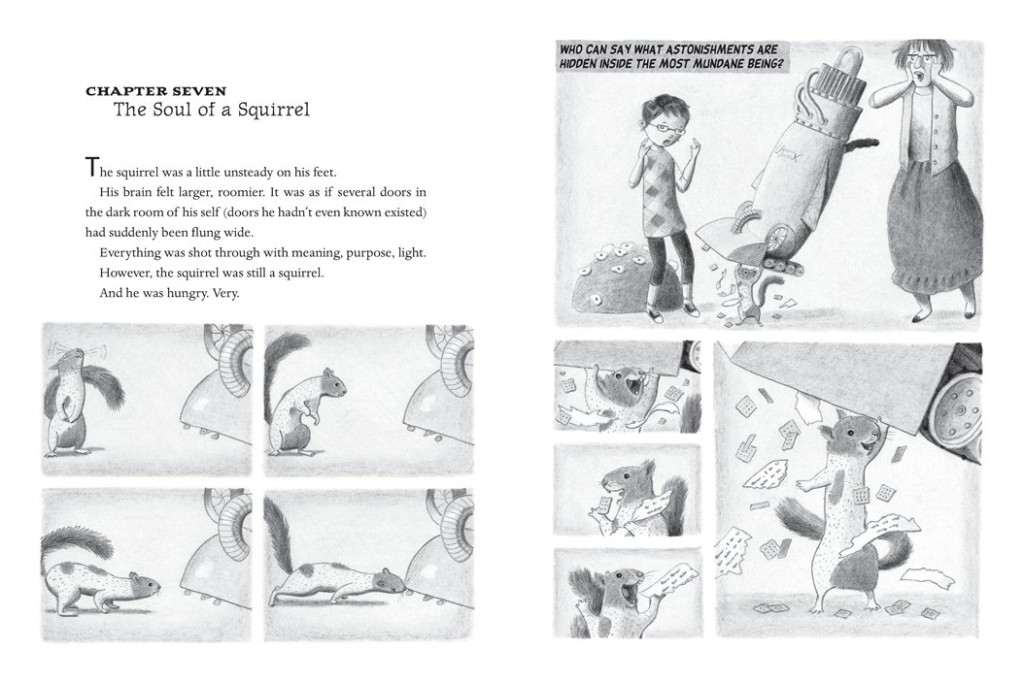
Here’s a page from Flora and Ulysses:

http://books.5minutesformom.com/wp-content/uploads/2013/09/flora-and-ulysses-inside-1024x682.jpg

It’s new to us but looks like a lot of fun, although, because of the semi-graphic-novel format, not suited to reading aloud… so, here we go, on with the read-alouds!

  • 014032609XThe Children of Noisy Village, by Astrid Lindgren.  This is the author of Pippi Longstocking, but if you’re hoping for another Pippi book, this isn’t it.  It’s a very – um, how shall I put it? – mild tale of a group of children growing up in Sweden of the 1940s or 1950s.  I think my kids like it because the children are exotic, but to me, everything exotic about them is kind of boring:  they run and play freely outdoors, and essentially choose their own fun.  Perhaps that’s exotic.  Oh, also, they celebrate Christmas, which is something my own Jewish kids can’t get enough of.  It’s wholesome and mildly eventful, in a Little House on the Prairie kind of way.
  • 100 First Stories (in Hebrew, 100 סיפורים ראשונים, חלק ב).  A collection of only-slightly-weird retellings of short classic fairy tales (like the Three Billy Goats Gruff), along with some Hebrew versions thrown in for fun.  Some friends of ours found this in a pile of donated clothing and books and gave it to us, but somehow, it has lost about 1/3 of the pages, making it perhaps 75 First Stories instead of all 100.
  • Purple Monster (in Hebrew, מפלצת סגולה), by Rinat Hoffer.  This is perfect for when I’m tired at the end of a long day, a not-too-challenging picture book from a new favourite author.  See?  Even in a language that’s hard to read, I have to keep an open mind!  For some mysterious reason, the word for “monster” in Hebrew (“mifletzet”) is feminine… so all monsters, regardless of their personal inclination, seem to be feminine.  This purple one is fabulously no exception.

There are a couple more that we pick up from time to time, but I’ll leave it here now.  Well, no, I’ll add in two more books… for our read-aloud Hall of Shame.  I don’t like to admit defeat, but I guess we’re all human, right?  So I’ll admit:  here are two books that have defeated my efforts to read them aloud in the last few months:

  • 1613823312The Jungle Book, by Rudyard Kipling.  Not really a kids’ book at all, or perhaps it is and I’m just reading it wrong.  We have had some success in the past with his Just So Stories, and I was hoping to add something of the classics into their mainly junky reading lately, but no… it just didn’t work out, so I shelved it for now. 
  • B0083Z614SThe Secret Garden, by Frances Hodgson Burnett.  Our failure with this one really shocked me because I love this book.  Love it from my own childhood and I still love it as an adult.  We read A Little Princess all the way through last year and everybody enjoyed it tremendously.  I think some of the themes in Secret Garden were just too weird, like the crippled Colin who keeps being told he’s going to die.  In any event, our interest sort of petered out and I didn’t bother trying to revive it.

What are you reading aloud these days?  When you read to your kids, do you think of the books you’re holding as “the competition,” or just sit back and enjoy them while you’re at it?

Saturday, January 11, 2014

Ebook or App: which should you write?

Kornacki Where Books Come to LifeHow do you feel about the ebook / book app revolution?

There’s a lot of bandwagon-jumping out there among self-published children’s authors these days.  Everybody, it seems, wants to publish not just a book but an app.  Indeed, there’s a bit of confusion; many people assume that if you can read it on a table, it MUST be an app – they’re confused about where the line is between ebooks and apps.

Though I’d step in and clarify. :-)

(Before I start, I must give credit for this amazing illustration to Christine Kornacki, whose site / blog and more artwork can be found here.)

So here’s where I draw the line.

  • If you sit down and read it, it’s a book.  The main verb here is READ.
  • If you can play with it, it’s an app.  The main verb here is PLAY.

In general (and feel free to challenge me with any exceptions you can think of!)…

  • An ebook is essentially words (and pictures) on the screen, in the same way that books are words and pictures on paper - the screen simply replaces the paper. Ebooks can be read on both ereaders and tablets (including ipads).
  • An app, on the other hand, although it can be based on an ebook, is far more interactive and usually includes games, sound, etc. These can only be read on tablets; most only on the ipad.

Many authors think they should automatically jump into whatever is newest and best, and I’ve seen a few people on work-for-hire sites offering to create interactive apps cheaply. 

There is also the woeful idea, in the minds of some lazy and/or unscrupulous writers, that they can take a less-than-wonderful book idea and conceal its flaws by turning it into an app instead.  Perhaps they can cover up the lack of plot or shallow characters with glitz and interactivity.  Caution:  not so fast, suckas! 

Here’s why I think you should steer clear of apps.  That’s right… I’ll say it again in bold:

If you’re a writer, steer clear of apps.

If you see yourself as an writer, with a burning need to create a children’s book, then do it:  write your book.  The verb here is WRITE.  You will basically go it alone, writing your book and either illustrating it yourself, submitting it to a publisher, or finding an artist on your own.  The core of the process is the writing and the final product will depend mainly on the quality of the writing.

You have all you need, right this minute, to create the best kids’ book in the world.

If, on the other hand, your idea is more about an an interactive fantasy world, you can think about creating an app.  Essentially, you will have to create characters, a whole bunch of interactive scenarios (multiple plotlines), and then bring them to life.  I’ve seen what it takes to create a high-quality videogame, and chances are, you don’t have the technical know-how to do it alone.  This is going to cost a bunch of money, and because other people will be involved, the quality will depend not just on your idea (which might be great) but on the others who bring it to life for you.

You do NOT have all you need to create the best kids’ app in the world.

Chances are, you can’t – create the best app, that is.  The market is flooded with cheap and flashy educational things for computers and tablets of all kinds.  Any idea you have has probably already been done better a thousand times.  If it’s what you really want to do, don’t let me discourage you, but if you believe your core talent is WRITING, then you’d better stick to WRITING.

With ebooks, on the other hand, there’s no barrier to entry.  You determine the quality of the final product by your own hard work.

ChildrenAccording to this infographic (click for original), apps are “ideal” for:  non-serial storytelling experiences (ie NOT books), well-known brands or characters (ie probably NOT your kids’ book) and significant marketing resources (ie probably NOT your budget).

Conversely, ebooks are ideal for:  serial reading experiences (ie books), the majority of titles (ie YOUR books), and lower barriers to monetization (ie it costs you less money).

What we “read” in our family.

Actually, no quotation marks are necessary.  In our family, we READ.  These days, since we live in a place where English-language books are rare and expensive, ebooks essentially are our future, and both kids are slowly coming around. 

My kids mainly use our ereader and tablets for actual reading - ie they sit quietly for hours turning pages and enjoying more-or-less traditional tales.  It took longer for our daughter, by the way, and she still can’t read for hours on the Kobo like she can with a print book.  Kids know the truth:  no matter how we may pretend, reading on a screen IS intrinsically a different experience from reading on a piece of paper.

B0058NUL6WThe main ereader the kids have access to (the grownups each have a tablet) is a Kobo Touch, in the alluring lilac quilted colour you see here.  This device is very limited… technically, it can access the Internet and it has a built-in Sudoku game, but these features are very awkward to use.  Essentially, what it does is display books on the screen.  It does a decent job of it and (with no backlight and a low-energy paper-white screen) has an incredible battery life.  It’s a couple of years old now, but there’s no reason it can’t last a good long time.

When it comes to apps, we’re limited in the kind and quantity we can enjoy, even on the Parental Tablets, because we don’t have an ipad, but I like to think that even if we did have one, I’m the type of parent who’d mainly steer her kids towards books, not apps.  I’ve seen a little of what’s out there, and (perhaps because I’m coming from a background of intense geekery in the videogame arena), I’m not terribly impressed.

I’m not dissing the potential of apps based on books!

Lest you think I’m anti-app… I’m not, believe me.  I see a well-done kids’ book app as the modern equivalent of the pop-up book, offering delightful surprises on every “page.”  I certainly don’t believe they mean the end of books, as many prophets of doom would have you believe.

(I would, however, treat apps as “screen time” instead of just “reading time” and limit kids’ access accordingly, but that’s a topic for another post.)

On the other hand, one big drawback I haven’t mentioned of apps, as opposed to ebooks, is that ebooks are generally offered in a universal format.  Apps are restricted to one device or platform, usually (these days) ipad or android.  That’s worth repeating, while I’m tossing out the bold fonts so liberally here:

Ebooks are universal; apps are single-platform.

A lot of writers don’t understand this, simply because they’re not coming at it from a technical standpoint.  Someone promises them an app, they test out the finished app and it’s good, so they go with it.  They don’t realize that they’ve just cut off some huge percentage of their potential readership.

(Some people pushing book apps may tell you that there are many confusing file formats in the ebook world, but most are similar enough to convert easily from one format / platform to another, unlike apps, which don’t port easily at all.)

Of course, if your book is a wild success, you can always think about turning it into an app later on.  If it’s picked up by a publisher, or if you already have a publisher and the book becomes successful, they may even find a way to do it for you, leveraging their resources to create an app that actually stands out.

Want to read more about the difference between ebooks and apps?

Are you planning to put out a book app?  Were you planning to but have decided against it?  Are you on the bandwagon or not quite sold on the idea?