Showing posts with label read-alouds. Show all posts

Thursday, July 27, 2017

If you want to write kids’ books–read, read, READ! (with 6 of this summer's favourites)

image

What’s the best way to ensure that you’re writing kids’ books that are relevant to today’s readers? 

When I say readers, by the way, you can assume I also mean all the gatekeepers between you and your readers: editors, agents, publishers, and anyone else who gets to vet your book before it’s approved for publication.

And the best way to make sure you’re writing the books they want to see is… to READ kids’ books.  A LOT of kids’ books.

Now – just to be very, very clear here, I’m not telling you a) to read books in order to copy them, or b) to read books in order to write more marketable books.  You probably shouldn’t be thinking about marketability as you’re actually writing your book.

But reading what’s out there on the children’s-book shelves will give you an edge in a few ways, by helping you answer the following questions for yourself:

  • Who are the protagonists of kids’ books today?
  • What kind of situations do they find themselves in?
  • What’s the art like?
  • How wordy are they?  (hint: not very!!!)
  • What kind of vocabulary do they use?
  • What kinds of resolutions / messages do publishers seem to prefer?

Now, if you’re like me and you live in a non-English speaking country, all of this puts you at a distinct disadvantage.  And even if you live in a totally English-speaking country, there are a few reasons you might not have visited your local bookstore or library lately. 

For example, many children’s authors are older parents or grandparents – you may have read a lot of kids’ books at one point, like when your kids were younger.  You just haven’t checked out new books recently.  But why should you bother?  Classics are classics are classics, and what makes a book great doesn’t change from one generation to the next… right?

WRONG.

Even when it’s difficult, you must check out what kids’ books are out there, not just to scope out the competition but to make your own stories stronger and more contemporary-feeling.

Here’s one tip that I sent around to my local SCBWI chapter a few months ago:  search for current popular kids’ books on YouTube.  We had just had a Skype meeting with a publisher in L.A., so everybody was fired up about writing books for a U.S. audience, but many people in the crowd weren’t really sure what that entailed. 

Fortunately, there are MANY popular kids' books being read aloud by native English speakers on YouTube, including many of the books the agent had placed on her recommended-reading list for authors submitting to her. 

Wondering what books she suggested???  Here are the two books she mentioned most:  Llama Llama Misses Mama (https://www.youtube.com/watch?v=9xB6i1ReuT8) (along with all the other Llama Llama books by Anna Dewdney!) and Dragons Love Tacos (https://www.youtube.com/watch?v=AUTmRJqwI_c).  I'm betting that whoever can write the next book like those will get a sweet deal from her publishing company!

I’m very lucky to be in Toronto visiting family right now, so I took this opportunity to walk into my local library last week to scope out (aka “take home half of”) the kids’ picture-book section. 

Here’s my haul:

image

These are all fairly recent.  I’d heard of two of these beforehand and was psyched to see them in stock:  School’s First Day of School by Adam Rex, and Yaffa and Fatima: Shalom, Salaam by Fawzia Gilani-Williams, from Kar-Ben, the same publishing company that published my book Yossi & the Monkeys.

The first of these, School’s First Day of School, has been on my wish list

Saturday, March 21, 2015

Beyond ABC and 123: 5 easy themes you can use to write picture books.

image

Do you love the light in the tiniest kids' eyes when they listen to a picture book?

"Theme" books, like ABC's and 123's are time-tested favourites for a reason.  The very youngest readers (and listeners) love seeing familiar patterns and concepts - numbers, letters, colours, shapes, sizes.  What would be deathly dull for us, as adults, is absolutely the hottest thing with little kids.

Lots of writers make the mistake of trying to mix things up for very young readers.  You have to keep them entertained, right?

Wrong.  Instead, make your life easier and try one of these five familiar themes.

Of course, if you want to sell parents on your idea, you'll still have to make it original to some degree.  But remember that it doesn't have to be all that original to charm buyers and knock little kids' socks off. 

A lesson about kids – from Malcolm Gladwell

image Malcolm Gladwell showed in his fantastic book, The Tipping Point, that when little kids had a choice, they would watch the EXACT SAME episode of the TV show Blue’s Clues every day for an entire week. 

Even the show’s creators were shocked. 

Not only were kids NOT bored, they were more excited and engaged every single time they saw the episode.

Tuesday, December 9, 2014

12 nights of Chanukah fun: a mega Jewish holiday picture book roundup

image

Before you read any further, you should know:  these aren’t exactly reviews.  They’re BETTER.

(That’s also why I want you to read this even if you don’t celebrate Chanukah.)

What could be better than reviews?

As writers, we’re at work even when we read for fun (even when we read to our kids), and that’s a serious job.  We have to examine each book not simply for whether or not we enjoyed it (like ordinary readers do), but analyzing it to figure out IF it works and HOW it works.

That’s the only way we can make our own writing better.

Working while we read (for pleasure)

When I took a children’s picture-book writing course earlier this year, I had to research “comps” – comparable books on a similar topic.  Since I was working on one of my Chanukah books, I decided to research what else was out there in the world of Chanukah books.  I chose these books almost at random, but I think it’s a good assortment of what’s out there.

Have fun reading through them, and hopefully discovering a few new favourites. 

  • How Do Dinosaurs Say Happy Chanukah? by Jane Yolen, illustrated by Mark Teague
  • Mrs. Greenberg's Messy Hanukkah, by Linda Glasser, illustrated by Nancy Cote
  • Esther’s Hanukkah Disaster, by Jane Sutton, illustrated by Andy Rowland
  • Chanukah Lights, by Michael J. Rosen, illustrated by Robert Sabuda
  • Latkes, Latkes, Good to Eat: A Chanukah Story, written and illustrated by Naomi Howland
  • The Story of Hanukkah, by David A. Adler, illustrated by Jill Weber
  • Sammy Spider's First Hanukkah, by Sylvia A. Rouss, illustrated by Katherine Janus Kahn
  • Biscuit's Hanukkah, by Alyssa Satin Capucilli, illustrated by Pat Schories
  • Elmo’s Little Dreidel, by Naomi Kleinberg, illustrated by Christopher Moroney
  • Light The Lights! A Story About Celebrating Hanukkah And Christmas, by Margaret Moorman
  • Engineer Ari and the Hanukkah Mishap, by Deborah Bodin Cohen, illustrated by Shahar Kober
  • Battle for Torah: The Message of Hanukkah, by Kay Kindall, illustrated by Neil Kindall

While you’re reading through these short blurbs, take a look at some of the different ways we – as writers –should be analyzing “comps.”

What to look for

Sunday, January 12, 2014

Read-alouds, aka checking out “comps.”

How are you at scoping out the competition??? 

In her children’s writing courses, writer Ana Suen makes all her students do a ton of reading and check out what she calls “comps” – essentially, your competition.  I definitely agree with her that if you’re going to write in a genre, you have to read in it, at length. 

Happily, I do.  I love reading out loud, and my kids seem to tolerate being read to, so it’s the best of every possible world.

Around here, we always have a few read-alouds on the go, at least.  Here are a couple of the books we’re slowly stumbling through.  Some more off-and-on than others:

  • 0763644323Because of Winn-Dixie, by Kate DiCamillo.  Going through a bit of a Kate DiCamillo phase, actually: we read The Tale of Despereaux not long ago, and I have a library copy of Flora and Ulysses on the tablet for them, too.  All highly recommended.  Guess I didn’t read enough reviews ahead of time, because I was surprised to find many references to alcoholism in Because of Winn-Dixie (the main character’s mother is a runaway alcoholic; another character is alcoholic as well), but it’s dealt with tastefully enough that it hasn’t shocked the kids so far.

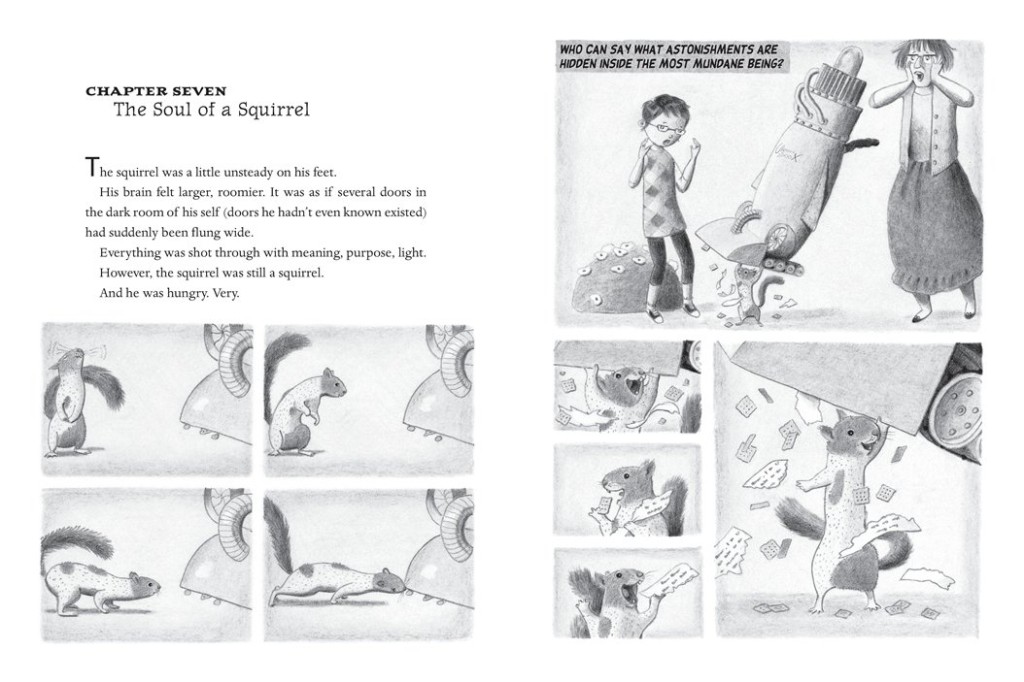
Here’s a page from Flora and Ulysses:

http://books.5minutesformom.com/wp-content/uploads/2013/09/flora-and-ulysses-inside-1024x682.jpg

It’s new to us but looks like a lot of fun, although, because of the semi-graphic-novel format, not suited to reading aloud… so, here we go, on with the read-alouds!

  • 014032609XThe Children of Noisy Village, by Astrid Lindgren.  This is the author of Pippi Longstocking, but if you’re hoping for another Pippi book, this isn’t it.  It’s a very – um, how shall I put it? – mild tale of a group of children growing up in Sweden of the 1940s or 1950s.  I think my kids like it because the children are exotic, but to me, everything exotic about them is kind of boring:  they run and play freely outdoors, and essentially choose their own fun.  Perhaps that’s exotic.  Oh, also, they celebrate Christmas, which is something my own Jewish kids can’t get enough of.  It’s wholesome and mildly eventful, in a Little House on the Prairie kind of way.
  • 100 First Stories (in Hebrew, 100 סיפורים ראשונים, חלק ב).  A collection of only-slightly-weird retellings of short classic fairy tales (like the Three Billy Goats Gruff), along with some Hebrew versions thrown in for fun.  Some friends of ours found this in a pile of donated clothing and books and gave it to us, but somehow, it has lost about 1/3 of the pages, making it perhaps 75 First Stories instead of all 100.
  • Purple Monster (in Hebrew, מפלצת סגולה), by Rinat Hoffer.  This is perfect for when I’m tired at the end of a long day, a not-too-challenging picture book from a new favourite author.  See?  Even in a language that’s hard to read, I have to keep an open mind!  For some mysterious reason, the word for “monster” in Hebrew (“mifletzet”) is feminine… so all monsters, regardless of their personal inclination, seem to be feminine.  This purple one is fabulously no exception.

There are a couple more that we pick up from time to time, but I’ll leave it here now.  Well, no, I’ll add in two more books… for our read-aloud Hall of Shame.  I don’t like to admit defeat, but I guess we’re all human, right?  So I’ll admit:  here are two books that have defeated my efforts to read them aloud in the last few months:

  • 1613823312The Jungle Book, by Rudyard Kipling.  Not really a kids’ book at all, or perhaps it is and I’m just reading it wrong.  We have had some success in the past with his Just So Stories, and I was hoping to add something of the classics into their mainly junky reading lately, but no… it just didn’t work out, so I shelved it for now. 
  • B0083Z614SThe Secret Garden, by Frances Hodgson Burnett.  Our failure with this one really shocked me because I love this book.  Love it from my own childhood and I still love it as an adult.  We read A Little Princess all the way through last year and everybody enjoyed it tremendously.  I think some of the themes in Secret Garden were just too weird, like the crippled Colin who keeps being told he’s going to die.  In any event, our interest sort of petered out and I didn’t bother trying to revive it.

What are you reading aloud these days?  When you read to your kids, do you think of the books you’re holding as “the competition,” or just sit back and enjoy them while you’re at it?