Showing posts with label writers block. Show all posts

Tuesday, November 21, 2017

Finishing your book–the “nibbled to death” way

image

I'm working on a book.  I've been at it for a while, in fact.  Years.  And guess what?  I'm on page 11 already!

So... okay. 

Go on. 

Say it to my face - exactly what you're thinking.

Which is probably something like, "That's not much for years of work."

"Page 11?  That's not very good."

"Eleven pages?  I could do better than that."

"A turtle could do better than that."

Yes, it's true.  Page 11 is not very far into a book.  It's going to take a loooong time to finish.  A year, to be exact.

But I will finish, I do know that.  And in a year, I will have a book under my belt.

When I started looking for images to use as the heading for this post, I was thinking seriously about a turtle, because a turtle is a great symbol for slow and steady winning the race.  We all recognize this guy from the Aesop’s Fable story, right? 

image

Yeah, yeah, turtles.

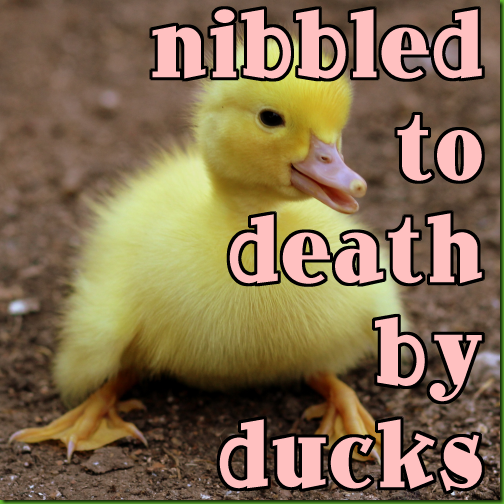
But really, a better image is ducks.  This guy:

image

There’s an expression I hadn’t heard before a few years ago, and it sums up my strategy for getting this book DONE, and that is:  "Nibbled to death by ducks." 

What does it mean?  Well, look at that duck.  He's pretty cute, right?  That beak totally doesn’t mean business.  He looks like a lightweight for sure.  If you let him nibble at you, he wouldn’t do much damage.  Unless he kept nibbling.  Just kept nibbling and nibbling and nibbling…

Well, okay, that’s getting a little gross.  My point being, one nibble by one duck doesn’t do much damage, but

Sunday, October 22, 2017

How to write more productively - by writing slower

image

Trying to figure out how to write faster?  Maybe you need to slow down.

I know, I know... that probably feels like the exact OPPOSITE of the advice you're looking for.

But maybe you've heard about the SLOW trend?
It's epitomized by the Slow Food movement, but in general it's a trend towards handmade, artisanal, more authentic living.

Last week, I sent out an email to friends on my list (join me by signing up at the bottom of this post!) with a call for YOU to tell me your biggest writing challenges. 

One writer wrote back that he struggles with writing regularly.  Not that he can't get what he calls his “butt in the chair,” but that he senses that writing at the computer is not as efficient as it's cracked up to be.  On the other hand, he said, any other approach (I guess this means writing by hand, but perhaps also dictation), means writing twice as much as necessary.

I can relate.  But still - I want to address two things:

  1. Yes, the computer is not terribly efficient unless you're one of these super-disciplined people who shuts down every background app, turns off your phone, maybe blasts some music, and writes non-stop for a timed session.  If you do, kudos to you.  Most of us can't do that.
  2. Writing by hand doesn't HAVE to be inefficient.

That’s what I want to talk about in this post.  How despite my love for writing on the computer – which I’m doing this second as I craft this post - I have also discovered the joy of writing by hand. 

Don’t worry, I won’t try to turn you into a luddite who shuns computers altogether (like I said, here I am!), but I do want you to start thinking of your hand as yet another writing tool, one which can help you write better and even (gasp!) more productively.

Hand writing as a discipline

Here’s how I was sold on the value of hand writing.

I haven't really mentioned here, but I'm 8/11ths of the way through a master's degree in Writing and New Media which I started in 2016 (yay, me!) and as part of that, I had to do a course in "developmental writing."  That means therapeutic writing, writing for personal development, writing as therapy, whatever you want to call it.

To pass that course, I had to take on a 3x/weekly practice of writing by hand for 20-minute sessions with a candle, a timer, and a playlist of baroque cello music by Yo Yo Ma. 

I wish I was joking.

You have to understand how hard this was for me.  I type somewhere between

Monday, May 15, 2017

Becoming a writer: Why knowing your strengths and weaknesses MATTERS

image

Are you feeling discouraged and thinking of giving up?  Or maybe you’re thinking about writing something but you just can’t get started?  Maybe you figure it won’t come out right – so why even bother.  Does any of that sound like you?

Maybe you just don’t know what you’re good at.

I talk a lot on this site about not just writing a book (just one book?) but about becoming a writer – looking at writing as a career (even if you already have a career!).  And part of becoming a writer is figuring out what you’re great at doing… and what doesn’t come so easily for you.

I think I’m good at writing – but when it comes to marketing, which is a big part of being a writer today (like it or not), I don’t think that’s one of my strengths.  What about you?

What are you super-good at?  I bet you know already, but maybe you haven’t spent enough time basking in it.  This could be something you’ve heard from a whole bunch of people.  Maybe you’re secretly proud but don’t want to seem like you’re gloating.

Take the time to enjoy your strengths.  In the table below, you’ll find a bunch of different writing tasks and you’ll have a chance to see exactly how many things you are probably quite good at doing.

Unfortunately, unlike in many careers, you can’t just work on a sub-specialty and ignore the rest.  You will eventually have to deal with everything I’ve listed in the table below – and then some.  But there are some very good reasons to go into writing with your eyes open – with a keen awareness of your own strengths and weaknesses.

Why figure out your strengths?

Identifying your strengths makes you feel good about yourself!  I’m not big into self-esteem just for self-esteem’s sake.  But if you genuinely ARE good at something, you deserve

Monday, July 6, 2015

3 ridiculously easy ways to get more words down on paper (a guest post)

image

We’re heading overseas for our big family vacation in Canada, so I’m turning over the rudder to the experienced hands of Australian writer Ruth Barringham, who’s here to talk about…

3 Ridiculously Easy Steps to Writing More

imageWe all have the same amount of hours in a day and it's usually not possible to complete everything on our daily to do list.

This is especially true when it comes to writing because not only is it something that we put off doing to last every day, but find it hard to concentrate because of the nagging feeling that we should be doing something else.

But what if you could sit down and write every day with 100% focus on your work and write more in the same time?

Is that something that you like to do?

Wednesday, July 1, 2015

The top-secret way to write more when you have young kids

image

School’s out!

Summer’s here, and if you have young kids, you know what that means: kids in your hair. 

All day long, and by evening, you’re sapped by family activities and running around.  Running, running, running.  They’re running you into an early grave… and you’re running on empty.

Where can you find time to write?

Some days (is this just me?), the thought of sitting down at the computer after a busy family-filled day is utterly, completely depressing.  I know there are disciplined writers out there who put in their 1000 words a day come hell or high water.  But I’ll admit it right now: I’m not always one of them.

Do you ever have a day when you feel like you’ve given them everything you’ve got?

I do.  Sometimes, I’ve given my kids everything in me and there is nothing – well, almost nothing – left.  But it’s that almost nothing that you have to take and squeeze out. 

Those very last drops of inspiration are sometimes the very sweetest.  

Giving more than 100%

Have you ever cut and squeezed a lemon? 

Sunday, April 26, 2015

How to be a bolder, more confident writer (hint: don’t baby your book!)

image

Once upon a time (don’t worry; this is a true story), when my older kids were little, my dad took them out to the park.  I came along after a while and saw he was pushing my son alarmingly high on the swing. 

“Daddy,” I said, completely on edge, “that’s WAY too high.”

“That’s okay,” he said.  “You can always make more.”

In that moment, a) I knew he was going to ruin my son’s life by pushing him too high, and b) my father knew it was perfectly safe and I was being a silly first-time mom (albeit one with two kids, but it was still early days).

(The fact that I did indeed go on to make two more kids is irrelevant.  My father knew nothing bad would happen.)

That’s how it is with your first book, too.

Getting over the apprehension

You need to get over it.  Just as I did with my new-mom apprehension.

When I put out my first children’s book, I really cared about every aspect of it.  I laid it out as well as I knew how at the time.  I threw myself entirely into editing and the cover.  (Those things are as it should be.  I hope you do them as well.)

But

Friday, October 31, 2014

Write better, sell more books. Under a buck.

image

Want to write better?  Want to sell more books?  All for under a buck?

Of course you do.

It doesn’t matter whether you’re writing children’s books, blogs, or full-length adult nonfiction (or anything else).  The basics of writing and publishing in a digital age are exactly the same.

Lots of self-proclaimed “experts” will tell you how you can cash in on some kind of digital gold rush, but they’re all lying to you.  Their tips are gimmicky and most won’t hold true for more than a few months at a time.

Just in time for NaNoWriMo, two bestselling writers and one exceptionally prolific writing team have put together the Indie Author Power Pack.  It’s coming out November 3rd, but if you buy it now, it’s 88 cents.  That’s 88 cents for three books. 

This is easily the best 88 cents you will EVER spend on your writing career.

I literally stumbled across this today on Amazon, so I have no clue how long the presale deal’s going to last.

My current favourite, Write, Publish, Repeat (which I bought in audiobook, but have never sat down and read), alone must be over 100,000; it’s a monster (check out my review of Write Publish Repeat, plus my interview with its author, writer dad Sean Platt).  And it costs $5 all by itself. 

Again, the bundle is 88 cents. 

Get the deal here.

NOTE:  US-based viewers may see a price of 99 cents.  I wrote and published this post before I thought to check how it showed up here.  Here’s a screenshot of how the site comes through at my end:

image

(Which is funny, because usually we pay MORE outside the U.S.)

Let’s take a look at the math.

Write. Publish. Repeat., by Sean Platt and Johnny B. Truant Let's Get Digital, by David Gaughran How to Market a Book, by Joanna Penn

That’s at least $15 worth of ebooks, and these aren’t some second-run thing put out by fly-by-nights who don’t know what they’re doing.  These are the superstars of self-publishing, who have been at it for years and want to share their ideas with you..

I just bought the bundle, and I can’t wait until it comes out.  You should, too, even if you already own one (or two) of the books.  Here’s your last chance for this post…

Get the deal here.

If you do get it, or if any of these books have helped YOU, let me know in the Comments.

Saturday, August 30, 2014

Inspirational quote infographics about kids, books and writing.

goodbook
Feel free to borrow and use any of these on your own site, facebook or elsewhere. 
I’d love a link back if you could include one.  Will update this page as new infographics and quotes are created.

Click each graphic to see full-size.
 inspirational quote “There’s more summer in September than in June.” – Sara Lapell
“There’s more summer in September than in June.” – Sara Lapell

inspirational quote “When I say to a parent, ‘read to a child,’ I don’t want it to sound like medicine, I want it to sound like chocolate.” – Mem Fox
“When I say to a parent, ‘read to a child,’ I don’t want it to sound like medicine, I want it to sound like chocolate.” – Mem Fox

inspirational quote “Any book that helps a child to form a habit of reading, to make reading one of his deep and continuing needs, is good for him.” – Maya Angelou
“Any book that helps a child to form a habit of reading, to make reading one of his deep and continuing needs, is good for him.” – Maya Angelou

inspirational quote “Books are a uniquely portable magic.” – Stephen King

“Books are a uniquely portable magic.” – Stephen King

inspirational quote “A good book has no ending.” – R.D. Cumming

“A good book has no ending.” – R.D. Cumming


What quotes inspire you???  Let me know in the comments!

Monday, June 30, 2014

Stuck in the middle? 6 cheats to get you out of your bind.

3779719335_b1a8745502_z

We’ve all been there.

You start a story, typing furiously in an attempt to get the words down as quickly as they are flashing through your mind. Then your fingers come to a screeching halt. Staring at the screen, you are stuck in the middle of the story wondering what happened to that inspiration. Get it back.

Here are 6 “cheats” that can pull you out of the glue when all you see is stuck.

Friday, June 6, 2014

Ten kick-in-the-pants tips to really get you writing.

image

Most people have a story somewhere deep inside. Some of those people believe that they would be good at telling that story. A tiny portion of those actually get their story written down.

Think you’ll get to it “later”?  It’s all too tempting to put off writing until some undefined time when you will feel more inspired, but if this is your dream then stop waiting and start writing. Here are ten tips that will help you get that story and those characters out of your head and down on paper.

Sunday, May 18, 2014

New life for old stories: 3 that have been done to death – and why you should write them anyway.

image

Searching for new ideas?  Give it up.  There are no new stories… as it says in the book of Ecclesiastes, “What has been will be again, what has been done will be done again; there is nothing new under the sun.” 

But don’t let that worry you.  Here are three books that have been written over and over and over… but which will always be fresh and interesting, with just a little spin.

Tuesday, April 8, 2014

Most children’s book writers fail… here’s why you don’t have to.

It’s easy to see why so many authors fail:  the market is flooded like no time before in history.  What will keep you afloat above the deluge? 

It’s not enough to just write something that’s never been written before… you have to make your book extraordinary.  But even that’s not enough. 

The secret?  Quit showing your book to family and friends.

Ditch the cheering squad and your odds of success will shoot through the roof.

That’s it. 

That is the difference between you and 90% of the failed kids’-book writers out there.

Are you fooling yourself into failure? 

You are if you’re…

Wednesday, March 12, 2014

The worst advice about writing: “a writer writes.”

In the movie Throw Momma from the Train, Billy Crystal’s memorable character, a frustrated writing teacher, used to intone wisely, “a writer writes… always.”

Probably the most common advice given to writers:  “writers write.”  It’s also balderdash.

Which you realize if you consider the flip side of the equation:  if you have written anything – an email, an excuse note for your kid’s teacher, a “Lost Kitten” poster – you’re automatically a writer.

Sometimes, even the best advice is wrong.  Like when you have a baby and everybody says, “sleep when the baby sleeps.”  Of course, it’s great advice in a universe where you have nothing else to do but look after the baby.

Better advice:  a writer writes… sometimes.

When I first saw the title of this QuickSprout blog post, A Simple Plan for Writing a Powerful Blog Post in Less Than 2 Hours (yeah, I read blogs about blogging, and QuickSprout is among the best!), I was horrified. 

Monday, December 30, 2013

Two kinds of authors.

There are two kinds of people who want to write kids’ books.  Which one are you?

I know, I know, I didn’t tell you what the two types are yet.

But I want you to think about it before I answer. 

Ask yourself:

  • Why do you want to write kids’ books?
  • What are my strengths as a children’s author?
  • What are my weaknesses?
  • Who do I want to write books for?

Okay, so what are the two types?  I’ll give them nicknames, but remember – these categories are very broad and these titles are just generalizations.

“The Mom Writer”

Not just for moms, this category includes grandmas, grandpas, aunts, uncles or friends - anyone who wants to share good stories with their own kids, grandkids, nieces, nephews and any other children in their lives.  These folks generally aren’t in it for the money, fame and adulation (which is good, because there isn’t much here).

A writer in this category usually has two huge things going for her:

  • Story – you know what they want to write.  Whether it’s based on truth (“the time grandpa ran away from home as a boy”) or fiction (“the penguin who wanted to live in Hawaii”), this is an incredible strength.
  • Audience – you know who you want to write for.  Believe it or not, authors often take a long time figuring out exactly who the story is for.  If you know that Mackenzie, who’s a 5-year-old girl, will really enjoy your penguin story, then you have a leg up already.

One big downside for those in this group is taking your story and making it more general – making sure that other 5-year-olds will also enjoy your book.  Another may be that you don’t have all the skills to take your words and make them absolutely perfect.  We’ll talk about both of these things more in a later post.

“The Pro Writer”

Okay, in truth there are very few actual, “professional” children’s writers, but that’s okay.  In this group, writers are probably hoping to make a little money while telling stories that are either important or fun.  This group may include teachers, librarians and others who enjoy sharing good books with children.

If you’re a writer in this category, you probably also have a few things that make you special:

  • Literature – generally, you love kids’ literature.  If you raised kids, you loved telling them stories.  You may have strong opinions about what makes a book great, good, or simply awful.
  • Writing skills – you may have a lot of writing experience, from your career or in your personal life.  Perhaps you’ve also written stories or articles for adults to enjoy, and you probably have a love of language that you’d like to incorporate into your kids’ stories.

In this group, the big downside may be a lack of specific direction – you know what you want to do but don’t know exactly HOW to get started.  You may not have a story fully-formed in your heart, just bursting to get out.  This is the group that’s most likely to suffer the dreaded Writers’ Block, but that’s okay… we can fix that, too!

If you don’t see yourself fitting into one or the other of these categories neatly, that’s okay.  There’s always going to be some overlap – moms who are natural wordsmiths, librarians with a story to tell.  That’s okay.

There is one more group… but this blog probably isn’t for them.

“The Gimme Big Bucks”

These are the people who are in it for the money – only for the money.  Or maybe the fame and fortune (perhaps they’ve never read a kids’ book to discover that the authors usually aren’t rich and famous?).  There are ways to self-publish children’s books (make that “books”) and try to get money quickly. 

One thing I’ve seen a lot lately is people who republish public-domain books.  They download the text free on Project Gutenberg, auto-design a spiffy cover, then “print” their own brand-new edition of Anne of Green Gables, Little Women or the Wizard of Oz.  They sell it for cheap to hook Amazon.com book buyers who don’t realize that their edition is full of typos (thanks to bad OCR when the original book was scanned) or formatted amateurishly so it’s almost unreadable.

(Formatting is another one of those things we’ll talk more about in a later post!).

Worse is when people like this swipe stuff (“swiper, no swiping!”) and put together a collection of items that aren’t public-domain:  illustrations, quotations, even story excerpts.  The self-publishing cops may catch up to them eventually, but generally, copyright holders need to pursue their own claims against these guys – there’s no organized effort to stop copyright violators in the print-on-demand world.

Another thing this type of person will do is put out a “series” of books, written quickly and badly, in an effort to become the next J.K. Rowling or Eoin Colfer.

Enough said about this type of person.  Let’s ignore ‘em and move on!

I hope those of us in the “good guy” categories can use this blog to come together to learn and share ideas to create and publish great kids’ stories together.  Deal?  Good!

Which type are you?  Do you fit neatly into one or the other of these categories, or do you belong in a special group all your own?