Showing posts with label writing. Show all posts

Tuesday, November 21, 2017

Finishing your book–the “nibbled to death” way

image

I'm working on a book.  I've been at it for a while, in fact.  Years.  And guess what?  I'm on page 11 already!

So... okay. 

Go on. 

Say it to my face - exactly what you're thinking.

Which is probably something like, "That's not much for years of work."

"Page 11?  That's not very good."

"Eleven pages?  I could do better than that."

"A turtle could do better than that."

Yes, it's true.  Page 11 is not very far into a book.  It's going to take a loooong time to finish.  A year, to be exact.

But I will finish, I do know that.  And in a year, I will have a book under my belt.

When I started looking for images to use as the heading for this post, I was thinking seriously about a turtle, because a turtle is a great symbol for slow and steady winning the race.  We all recognize this guy from the Aesop’s Fable story, right? 

image

Yeah, yeah, turtles.

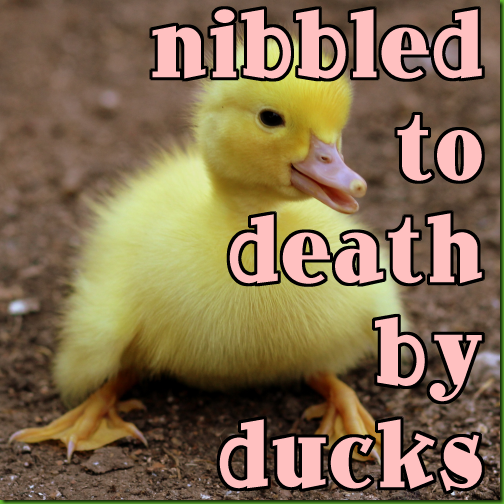
But really, a better image is ducks.  This guy:

image

There’s an expression I hadn’t heard before a few years ago, and it sums up my strategy for getting this book DONE, and that is:  "Nibbled to death by ducks." 

What does it mean?  Well, look at that duck.  He's pretty cute, right?  That beak totally doesn’t mean business.  He looks like a lightweight for sure.  If you let him nibble at you, he wouldn’t do much damage.  Unless he kept nibbling.  Just kept nibbling and nibbling and nibbling…

Well, okay, that’s getting a little gross.  My point being, one nibble by one duck doesn’t do much damage, but
Sunday, October 22, 2017

How to write more productively - by writing slower

image

Trying to figure out how to write faster?  Maybe you need to slow down.

I know, I know... that probably feels like the exact OPPOSITE of the advice you're looking for.

But maybe you've heard about the SLOW trend?
It's epitomized by the Slow Food movement, but in general it's a trend towards handmade, artisanal, more authentic living.

Last week, I sent out an email to friends on my list (join me by signing up at the bottom of this post!) with a call for YOU to tell me your biggest writing challenges. 

One writer wrote back that he struggles with writing regularly.  Not that he can't get what he calls his “butt in the chair,” but that he senses that writing at the computer is not as efficient as it's cracked up to be.  On the other hand, he said, any other approach (I guess this means writing by hand, but perhaps also dictation), means writing twice as much as necessary.

I can relate.  But still - I want to address two things:

  1. Yes, the computer is not terribly efficient unless you're one of these super-disciplined people who shuts down every background app, turns off your phone, maybe blasts some music, and writes non-stop for a timed session.  If you do, kudos to you.  Most of us can't do that.
  2. Writing by hand doesn't HAVE to be inefficient.

That’s what I want to talk about in this post.  How despite my love for writing on the computer – which I’m doing this second as I craft this post - I have also discovered the joy of writing by hand. 

Don’t worry, I won’t try to turn you into a luddite who shuns computers altogether (like I said, here I am!), but I do want you to start thinking of your hand as yet another writing tool, one which can help you write better and even (gasp!) more productively.

Hand writing as a discipline

Here’s how I was sold on the value of hand writing.

I haven't really mentioned here, but I'm 8/11ths of the way through a master's degree in Writing and New Media which I started in 2016 (yay, me!) and as part of that, I had to do a course in "developmental writing."  That means therapeutic writing, writing for personal development, writing as therapy, whatever you want to call it.

To pass that course, I had to take on a 3x/weekly practice of writing by hand for 20-minute sessions with a candle, a timer, and a playlist of baroque cello music by Yo Yo Ma. 

I wish I was joking.

You have to understand how hard this was for me.  I type somewhere between

Tuesday, January 17, 2017

Want to teach values in a kids' book? Put them in the background!

image

Got a message you’re dying to share?

I’ve been there.

But those of us who do have a real problem.

I’m sure you’ve heard before – and I’ve certainly said it before – that kids’ books shouldn’t be used to preach at kids.  If you put that message first and fill your book chock-full with good healthy values, you’ll end up with a terrible book that kids simply won’t enjoy.

Think of zucchini.  Nobody in my family likes zucchini very much.  If you adore zucchini, think about another vegetable.  Eggplant, maybe.

Now, you know you should eat zucchini.  It’s super-good for you, right?

But if I were to cook up a big batch of zucchini for my family, they’d all sit and stare at it – myself included – and not know what to do with it.  That zucchini would sit uneaten on the plate.

Now here’s the cool part:  we actually eat a LOT of zucchini.  We eat it sliced into chicken soup every Friday night; we eat it grated into latkes and any number of savoury dishes; we eat it pureed into potato soup.  I’ve even baked zucchini bread, though yes, I understand, it’s not entirely super-good for you if it’s surrounded by flour and sugar!

The trick to zucchini, or whatever veg you don’t like very much, is to put it in the background, and the same is true for morals, values, or any other type of lesson you’d like to embed in your book.

In my new book, Yossi and the Monkeys (2017, Kar Ben Publishing), there are a ton of what the publisher probably calls Jewish values, but which I consider pretty universal.  Here’s the first page:

image

What values are here – in the background?  There are things Yossi really wants, but they are not selfish wishes; they are things he wants for his family. 

(So I don’t have to come out and say something annoying like, “Don’t be selfish!”  Kids know that already anyway, so they’ll just tune you out if you try.)

The holiday itself is another value right here on this front page:  I love writing stories with Jewish holidays in them but which aren’t about the holiday.  There are too many “what is Chanukah?” books out there for me to want to contribute to the genre, plus those kinds of books have always bored my children, who have known since infancy what all the holidays are about.

(Notice I haven’t said: “Shavuot is a wonderful festival in which Jews…”  This book isn’t about Jews in general, so forget about them.  This is Yossi’s story.  Just in case the reader isn’t familiar with the festival, the publisher has included a short paragraph about it on the copyright page.)

Here are two more pages from later in the story:

Tuesday, September 6, 2016

The Bare Naked Manuscript: how to format your story for submission

image

Is your manuscript naked?

If it is – give yourself a hand.

If it isn’t, or if you don’t know what I’m talking about, read on… I’m going to give you in a few simple steps explaining how to get naked – and why you MUST, if you want to give it a chance of success with agents and editors.

Before you send out that manuscript, hold on a second… take a minute to make sure it’s naked.  By which I mean absolutely clean and clutter-free, ready for an agent or editor to take one look and say… YES!

Who wouldn’t want that?  Yet many writers I’ve known spoil their manuscript by adding things, covering up its nakedness.  Trust the agent; trust the editor.  They’ve handled more books than you’ll ever write, and they’ll be able to see your story’s potential even without the fancy touches.

Even bare naked.

Here’s a quick and easy checklist to make sure your book is as naked as possible before you send it out:

Saturday, September 3, 2016

The 5 biggest mistakes when you’re choosing your book title

image

Are you killing your chances before anyone even starts reading your book?

I hinted in my post last week that you can’t really go wrong when you’re choosing book titles.  Except you can.  It’s not easy, but it is definitely possible to choose a lousy title for your kids’ book.

It’s all about cracking the “cover” of your book, real or virtual.  Whether you’re self-publishing or sending your book around to agents or publishers, you need a title that’ll get readers onto page one, where hopefully, your story will do the work of hooking them in for good. 

True, publishers may change the “working title” of a book once they decide to publish it, but you’re still going to need a name for your book that hooks them into reading the thing in the first place.  So try to avoid these FIVE big mistakes.

Friday, September 2, 2016

What should you name your children’s book?

image

Hi, there.  What’s your name???

It’s the first question we ask most people, and when we’re looking for a book, we ask it (in our minds), before we even crack open the cover.

But what if you can’t think of a good name?

What is a good name, anyway?

A lot of writers worry that they might choose the WRONG name and that it’s going to hold their book back.  So before we get started, I have some great news for you:

Your book’s title doesn't have to be awesome… or even poetic. 

Thursday, August 25, 2016

Duckies, dragons, dinos: how old is your reader?

image

Can you tell the difference between a three-year-old and a ten-year-old?

I’m guessing you answered yes to that question.  But do you ask yourself this question when you sit down to write a picture book?  When you’re writing the thing, of course, it’s most important to follow your inspiration and get the words down on the page (screen!). 

But once you’re ready to think about submitting it or publishing it yourself, it’s a different story.  THEN you have to start thinking about audience.

Somebody got in touch the other day to chat about a kids’ book project and he happened to mention that the book was aimed at “kids ages three to eleven.”

Three to eleven???

Thursday, July 23, 2015

Beat the blahs with these zesty local story setting ideas

image

Think about a story you've written.  Where is it set?

Now think about where you live.  In the city, the countryside, a small town, a suburban hub?  A farm, a trailer, an apartment, a cottage, a motor home?  In North America, or Asia, or Chile?

Some of us naturally write stories set where we live.  In the vegetable patch in back of our farmhouse, or in the driveway of our one-storey suburban house, or the elevator to our twenty-fifth storey penthouse.

imageOther writers pick a location that's as exotic as possible.  If they live in Canada, they'll set their story in Thailand or Bengal or Nigeria.  (Or, if they're from Nigeria and live in Wales, like Atinuke, author of the lovely Anna Hibiscus series, they'll write a story set - in part - in Canada!)

While writing about a place you DO know well may sound dull, the truth is that some of the most-loved children's books take place in settings that are very similar to places the authors live or lived.  Places they know well, almost like the back of their own hand.

And the good news is that wherever you live, it's bound to be exotic to somebody. 

Right now, I'm visiting Toronto with my family, after nearly two years living in Israel.  This is my home town; I grew up here. 

Monday, July 6, 2015

3 ridiculously easy ways to get more words down on paper (a guest post)

image

We’re heading overseas for our big family vacation in Canada, so I’m turning over the rudder to the experienced hands of Australian writer Ruth Barringham, who’s here to talk about…

3 Ridiculously Easy Steps to Writing More

imageWe all have the same amount of hours in a day and it's usually not possible to complete everything on our daily to do list.

This is especially true when it comes to writing because not only is it something that we put off doing to last every day, but find it hard to concentrate because of the nagging feeling that we should be doing something else.

But what if you could sit down and write every day with 100% focus on your work and write more in the same time?

Is that something that you like to do?

Friday, July 3, 2015

5 ways breaking rules makes your writing more powerful (a guest post)

image

We’re getting ready for our big family vacation in Canada, so I’m turning over the steering wheel to the capable hands of author and speaker Dawn Goldberg Shuler, who’s here to talk about…

5 Reasons to Break Writing Rules

imageAs a lifelong writer, former English teacher, and writing coach and communication consultant for the last ten years, most people think that I write perfectly, no mistakes in grammar, structure, punctuation... it's all perfect.

Nope! I don't write perfectly at all. Actually, I don't know that I ever write anything that an English teacher wouldn't get her red pen out for (case in point).

I do it on purpose. I start sentences with "And" or "But." I use ellipses as if I have a huge box of them, and they must be used! I use slang; heck, I use my own made-up words like "baddies." I end sentences with prepositions. I use numbers instead of writing them out. Sometimes my sentences are not complete sentences.

With my writing background, why in the world would I break writing rules? Here's the thing... I know exactly what the rules are, and, more importantly, I know WHY I'm breaking them. I have a reason.

Those reasons usually fall into one of five areas:

1. Makes the writing more conversational.

Makes the writing more conversational, so that it sounds as if I'm actually talking to you.

Wednesday, July 1, 2015

The top-secret way to write more when you have young kids

image

School’s out!

Summer’s here, and if you have young kids, you know what that means: kids in your hair. 

All day long, and by evening, you’re sapped by family activities and running around.  Running, running, running.  They’re running you into an early grave… and you’re running on empty.

Where can you find time to write?

Some days (is this just me?), the thought of sitting down at the computer after a busy family-filled day is utterly, completely depressing.  I know there are disciplined writers out there who put in their 1000 words a day come hell or high water.  But I’ll admit it right now: I’m not always one of them.

Do you ever have a day when you feel like you’ve given them everything you’ve got?

I do.  Sometimes, I’ve given my kids everything in me and there is nothing – well, almost nothing – left.  But it’s that almost nothing that you have to take and squeeze out. 

Those very last drops of inspiration are sometimes the very sweetest.  

Giving more than 100%

Have you ever cut and squeezed a lemon? 

Monday, June 29, 2015

How strong is your story's opening? Turbocharge it with this 5-point checklist

image

Did you ever watch a space shuttle launch? 

It was an awesome thing: the thundering noise, the heat, the deep bass rumble.  Why do they have to put so much energy into launching ships into space?  They have to start out with a ton of power so the ship has enough velocity to make it all the way into space.

And that's what your story has to do, too.

Adding rocket fuel to your book

Pour a ton of thrust into the story's opening to carry readers all the way through to the end.  Here's a quick 5-point checklist to make sure your opening covers all the bases.

If you're writing a chapter book, you should include all these elements in the first chapter, preferably in the first half of the first chapter.   In a picture book, you'll want all of this on the first one or two pages.  That seems tight, but remember that your illustrations are going to be doing at least half the work.

Ready?  Get out your red pencil... here's the checklist:

Does your story's opening...

image1) …Introduce the main character?

We should get a clear idea of who this character is and what they're going to want in the story.  Show, don't tell. Let the illustrations do part of the work here, and whatever you do, don't start with the character's name and age.

Thursday, June 4, 2015

Write like a journalist: use the 5 W’s to write captivating children’s books.

image

How are you on the 5 W’s? 

You know:  “who, what, when, where, why”?  Those 5 W’s.  The ones your high school English teacher badgered you about. 

Maybe you’ve pushed them aside and not thought about them since high school.  But it’s time to dust them off and see how they can help you create a tighter, more fascinating story.

Every journalist knows that if they haven’t answered these 5 W questions in the very beginning.  So should every story writer. 

Open up any newspaper in the world and you’ll see how those 5 W’s have been worked into the first paragraph – known as the “lede.”  Here’s a short news item from Reuters today:

An explosion at a gas filling station in Ghana's capital killed at least 78 people, many of whom had sought shelter there due to torrential rain, a spokesman for the national fire brigade told JOYFM radio on Thursday.

Let’s take a look at those 5 W’s.

  • Who’s it about?  78 people who were killed, and one fire brigade spokesman.
  • What happened?  An explosion.
  • When?  Today, Thursday June 4 (or maybe it happened yesterday).
  • Where?  Accra, the capital of Ghana.
  • Why?  The people were in the gas station to seek shelter from the rain.  The article doesn't given a reason for the explosion itself, but the next paragraph says it may be connected to the rain as well.

Oh, and by the way, I know nothing about Ghana.  That’s another thing journalists realize:  if they’re doing their job right, they can make you feel entranced, utterly fascinated, by anything.  They can make you care.

Now let’s look at the beginning of a children’s book.

Friday, March 27, 2015

Best of the (Kids-Book) Writing Online this week: March 27, 2015

image

An occasional roundup of blogs and other writings for kids’-book writers and illustrators… stuff that’s inspiring me, so I hope you’ll enjoy it, too.

1. Are we turning teens into readers… or turning them off reading?

Over at Writers Rumpus, Marti Johnson asks, ”why is it that our high school age students abandon – no change that to – are driven from reading?”  Does required reading instill great habits, or just make teens resent books? 

I had spent two months of the summer prodding, pleading, arguing, punishing and bullying this 16-year-old into reading a classic that he will now abhor for the remainder of his life. I decided to read it. Well, I hated it too. As a matter of fact, I didn’t finish reading it. IMHO, it was AWFUL.

Read more from Writers Rumpus in How to Build Better Readers: IMHO

2.  Want to write a book with “Happy Birthday” in it?

Or any other song, for that matter?  Chances are, you will write a book someday that has lyrics in it.  Do you know how to do it without getting yourself sued?  Helen Sedwick explains that it’s not as tough as you might think.  She also lays out some great alternatives if you don’t want to pay.

Thursday, February 5, 2015

Building an author mailing list: PART 3, How to get started (the nitty-gritty).

image

Ready to get started?

Great.  Let’s roll up our sleeves and dig in.

I hope I’ve convinced you that an author mailing list is a great way to chat directly with people who love your writing. 

(If you’re not convinced yet, go back and read Part 1 of this 3-part series to find out why you need an author mailing list.  Then read Part 2 about how to convince readers to sign up (hint:  just ask them).)

So now the question is, where do you start?

Step 1:  Choose a provider

There are a few email list providers.  Some let you get started for free.  The top two are Mailchimp and Aweber.  I use Mailchimp, mainly because it was free to start out, and slightly less expensive on an ongoing basis, but to be honest, I don’t love it.  Aweber looks like it starts at around $29 a month, but they let you try it for a month for $1.

Monday, January 19, 2015

Building an author mailing list: PART 2, Calls to action.

image 

You know you want one.  You know you NEED one.  But how do you GET one in the first place?

(If you’re not convinced yet, go back and read Part 1 of this 3-part series to find out why you need an author mailing list.  And then take a look at Part 3, which takes you through the (super-easy) steps to get started.)

The best way to build your mailing list is… to let readers know it exists.

Sounds simple, right?

But are you doing it?  The way to do it right is with a call to action at the back of your book.  Calls to action are known as CTA in the marketing business, so that’s what I’m going to call them here.

Notice I said marketing business.  Lots of writers feel kind of slimy when they think about marketing.  If you do, that’s something you’ll have to get over.

A back-of-book CTA should be super-simple.  This is a two-step format that every reader will recognize:

Sunday, January 11, 2015

Building an author mailing list: PART 1, Do you need one?

image

Do you need an author mailing list?  Yes, you do.

Seriously.  You need a mailing list, period.

This is Part 1 of a 3-part series that will convince you that you do.  And prove that it’s super-easy to get started.  Part 2 will show you how to get readers to sign up, and Part 3 is the nitty-gritty how-to (but don’t worry, it’s easy to get started).

If things were different, if Amazon and other sites told you who was buying your stuff, or gave you access to their information, then I might not think you need a mailing list at all.  Then again, do you want those sites to control your relationship with readers?

Didn’t think so.

Amazon is not your friend.  Amazon wants to suck your buyers in, then grab their info so they can sell them other writers’ books. 

Pretty nasty, huh?  So that means you’ve got to look out for yourself.  (Not to mention that you may want to sell through other sites, besides Amazon.)

Still, you might not understand exactly why you need a mailing list.  Maybe one of these sounds like you…

Monday, November 24, 2014

Fever Pitch: 1-step first aid for sick stories

image

Is your story sick?  Something not quite right?

Your spelling and punctuation may be perfect, but if something just seems off… if it’s under the weather, but you’re not sure how to fix it…

… just pitch it.

No, I don’t mean throw it away.  I mean create a sales pitch and start selling your book.  Not (yet) on Amazon, or Kobo, or Smashwords, or anywhere else.  No, to make it great, you have to sell the story to your most important customer – yourself.

You’ll do that with a “pitch.”  Known by a few different names, it’s basically a 1-2 sentence “elevator speech” for the book.  This pitch has to be great.  It must hook the reader – and before it’s ready for readers, it has to hook YOU.

Wednesday, November 12, 2014

How to be a Super Blogger in 2015 (or why you should give up now).

image

You may have noticed that I don’t just write children’s books. 

And I don’t just write adult books.

A lot of what I write is here before you on this site.  For better or worse, I’m a blogger.  I’ve been at it for almost a decade.

When I started, I was a mom with a newborn, and that newborn turns 10 this winter.  She’s not the same, and neither am I.  And neither is the state of the blog world.

Here’s my “state of the blogger” analysis of what’s going on in the blog world.

Good news, bad news

The bad news

Blogging is very 2005.  When people hear that you have a blog, they run and hide.  It’s not a cool thing at all.  Hardly anybody under 30 has a blog, it seems.  They don’t have time to read anything more than about 175 characters.  Go over 500 words and you’re downright long-winded.  (Hope I didn’t lose anybody mid-paragraph.)

The good news

Some blogs today are very, very good.  Excellent, even.

The bad news

The good blogs are usually selling something.

Friday, November 7, 2014

How’s that pigeonhole working out for you? The pros and cons of genre-hopping.

image

How does your pigeonhole feel?  Nice and cozy?  Warm and safe?

Yeah, okay, I’ll admit it.  I don’t like being in pigeonholes.  Maybe you don’t either.

I like to stretch my wings, kick my legs, and fly free, as the mood strikes.  Isn’t that what makes what we do art instead of just churning out ad copy (though there’s definitely an art to that as well).

There are two schools of thought when it comes to “genre-hopping.”