Showing posts with label bookshelf. Show all posts

Friday, February 9, 2018

What the Cat taught me: Lessons for authors from yesterday’s book covers

image

Do you have a favourite book from childhood?  You can probably visualize its cover, right? 
Just picture it in your mind's eye and maybe feel the nice, contented feeling that comes with curling up with a delicious book...

Well, this morning, I came across one of my preteen favorites sitting open on the floor where my daughter had left it when she went to school:  The Cat Ate My Gymsuit, by Paula Danziger:

image

This book meant a lot to me as a kid.  I think it was because of its open acknowledgment that life is sometimes lousy when you’re a teenager but also the gentle message that (thanks, Dan Savage!) it gets better.  That there is a light at the end of the tunnel.  And it does all that with the good-natured humour that the late Paula Danziger brought to all her books.image

I posted this picture on Facebook because it brought back so many memories.  But I also started thinking about both how dated the cover looks (it's from 1978) and also how I doubted publishers would put a picture like this, showing a slightly overweight, slightly depressed teen on the cover of a book today.

Searching Google to find a history of this book cover, and I discovered I was right.  The most current version of this book, on Amazon, just shows

Thursday, July 27, 2017

If you want to write kids’ books–read, read, READ! (with 6 of this summer's favourites)

image

What’s the best way to ensure that you’re writing kids’ books that are relevant to today’s readers? 

When I say readers, by the way, you can assume I also mean all the gatekeepers between you and your readers: editors, agents, publishers, and anyone else who gets to vet your book before it’s approved for publication.

And the best way to make sure you’re writing the books they want to see is… to READ kids’ books.  A LOT of kids’ books.

Now – just to be very, very clear here, I’m not telling you a) to read books in order to copy them, or b) to read books in order to write more marketable books.  You probably shouldn’t be thinking about marketability as you’re actually writing your book.

But reading what’s out there on the children’s-book shelves will give you an edge in a few ways, by helping you answer the following questions for yourself:

  • Who are the protagonists of kids’ books today?
  • What kind of situations do they find themselves in?
  • What’s the art like?
  • How wordy are they?  (hint: not very!!!)
  • What kind of vocabulary do they use?
  • What kinds of resolutions / messages do publishers seem to prefer?

Now, if you’re like me and you live in a non-English speaking country, all of this puts you at a distinct disadvantage.  And even if you live in a totally English-speaking country, there are a few reasons you might not have visited your local bookstore or library lately. 

For example, many children’s authors are older parents or grandparents – you may have read a lot of kids’ books at one point, like when your kids were younger.  You just haven’t checked out new books recently.  But why should you bother?  Classics are classics are classics, and what makes a book great doesn’t change from one generation to the next… right?

WRONG.

Even when it’s difficult, you must check out what kids’ books are out there, not just to scope out the competition but to make your own stories stronger and more contemporary-feeling.

Here’s one tip that I sent around to my local SCBWI chapter a few months ago:  search for current popular kids’ books on YouTube.  We had just had a Skype meeting with a publisher in L.A., so everybody was fired up about writing books for a U.S. audience, but many people in the crowd weren’t really sure what that entailed. 

Fortunately, there are MANY popular kids' books being read aloud by native English speakers on YouTube, including many of the books the agent had placed on her recommended-reading list for authors submitting to her. 

Wondering what books she suggested???  Here are the two books she mentioned most:  Llama Llama Misses Mama (https://www.youtube.com/watch?v=9xB6i1ReuT8) (along with all the other Llama Llama books by Anna Dewdney!) and Dragons Love Tacos (https://www.youtube.com/watch?v=AUTmRJqwI_c).  I'm betting that whoever can write the next book like those will get a sweet deal from her publishing company!

I’m very lucky to be in Toronto visiting family right now, so I took this opportunity to walk into my local library last week to scope out (aka “take home half of”) the kids’ picture-book section. 

Here’s my haul:

image

These are all fairly recent.  I’d heard of two of these beforehand and was psyched to see them in stock:  School’s First Day of School by Adam Rex, and Yaffa and Fatima: Shalom, Salaam by Fawzia Gilani-Williams, from Kar-Ben, the same publishing company that published my book Yossi & the Monkeys.

The first of these, School’s First Day of School, has been on my wish list

Tuesday, July 4, 2017

Blog tour for SCRIBBLE & AUTHOR! by Miri Leshem-Pelly

image

I am so, so thrilled to be hosting today’s stop on the month-long blog tour for my real-life friend and faithful critique group companion Miri Leshem-Pelly… and her new book, Scribble & Author (Kane-Miller Picture Books, 2017)!  Check out yesterday’s stop at PUYB Virtual Book Club – as well as tomorrow’s stop, when it’s posted, at Interview at Literarily Speaking.  So much fun!!!

As children’s writers all know, though, the book isn’t really about us, the writers.  It’s about our CHARACTERS.  And that’s why, for today’s blog tour stop, I decided to host an interview not with Miri herself (check out this interview for that, or Miri’s website, if you’re interested!) – but with her character, Scribble!

Why did I want to talk to Scribble?  Well, take a look and see for yourself:

image

Isn’t she adorable???  Just so sweet and full of spunk.  Miri is an author/illustrator – so she gets to create her own characters.  I’m so jealous.  But it’s not enough to CREATE a character – as writers we know that we have to put our character in fascinating situations. 

Here's what the book is about, in a sweet little nutshell (from the publisher):

In Scribble & Author, Scribble's journey starts on a peaceful shore called THE BEGINNING, continues to the rough, adventurous MIDDLE, and leads finally to the gate of THE ENDING, but it's not at all what Scribble expected...
Scribble is a scribble and Author is an author, but who really gets to tell the tale?
An innovative picture book about finding your own voice, making your own decisions, and writing your own story.

Most importantly, as Scribble learns in the book, whether we’re illustrating our story or not, we also have to CHALLENGE our characters – even though we love them, we have to put them in plenty of danger and then let them find their own way out.

All of which is to say, it’s not easy being a character in a children’s picture book – especially given that element of danger.  So naturally, Scribble had lots and lots to say about her own adventures and being a character in this amazing book. 

Let’s listen in:

WKB: Hey, Scribble. It’s great to meet you! How does it feel now that you’re getting all this attention?

Thank you! Finally somebody’s paying attention to me – the main character! You know, the name of the book is Scribble & Author, not Author & Scribble, but for some reason, all other bloggers chose to interview the author instead of me!

WKB: Can you tell me how you first met Author?

When I first opened my eyes I saw Author, right there in front of me. I was very excited to discover that I was inside a book. But let me tell you something - I’m the only one who gets to see Author. Readers don’t see Author. They can read what Author says but they don’t really know who Author is: a man or a woman? Maybe a boy or a girl? I’m the only one who knows. And I’m not telling! It’s my secret.

image

WKB: Tell us the truth. Does it tickle when you’re being drawn?

You bet it is. I love being

Sunday, February 5, 2017

From Manuscript to Commercially-Published Book in 12 VERY Easy Steps

image

Have you ever asked the question – if I self-publish, does that mean I’m stuck self-publishing forever?

A lot of writers think they’re stuck defining themselves as one or the other, either a “self-published writer” or a “commercially-published writer.”  I hope you haven’t fallen into that trap!

In fact, you don’t have to pigeonhole yourself that way, as I hope I’ve proved with the release of my first book from a commercial publishing company, Yossi & the Monkeys (Kar-Ben, 2017).

So what’s it like having a book commercially published after so much self-publishing experience?

It’s weird, that’s all I can say.  It’s all about sitting back, relaxing, and WAITING, because this thing took – well, forever.

But still – I thought it would be fun to break it into steps, like in my last post, so you can see what was involved along the way.  So here we go… with Step 1.

Step 1.  Contest submission.

It all started back in 2014 with a Jewish kids’ story contest at Barbara Krasner’s website.  I entered, didn’t win, didn’t even come close.  But a real editor was reading!

Trouble was, my story came in at around 10,000 words (what was I thinking???).  It had 10 chapters, it was an EPIC.  Oops… wayyyyy too long!  Here’s Chapter One.

image

2. Contest rejection

Well, needless to say, this 10,000-word behemoth was rejected – with just about the nicest rejection note I have ever, ever seen:

image

She liked it!  She really did!  Considering I hadn’t paid anything to enter this contest, it was a delight to receive a positive reply like this.

Only trouble was… how to get the story down THAT small?  10,000 words to 850 words???

Thursday, May 21, 2015

Are your books too babyish? The grown-up way to write kids’ books, with 3 easy fixes.

image

Writing for kids keeps us young at heart.  How great is that?

(Very!!!!)

But maybe you’ve made the mistake of thinking that “young at heart” means writing in a childish way.  Are you underestimating your readers’ intelligence?  Is your children's book TOO childlike? 

Sure, we’re writing for kids.  Sure, I feel like a kid when I write.  But we shouldn’t make the mistake of creating books that sound like they’re written by kids – or worse, babies. 

Here are three common problems, and quick fixes to make sure you don’t fall into these traps.

1.  Baby talk

Language development experts say parents should try to speak normally to even the youngest kids.  Some “goo goo” is fine if we’re playing around, but when you’re talking to a baby, you should make an effort to use real words.

Same thing if you’re writing for kids, even babies.  Use real words.  A grown-up is going to be reading the story, so you don’t have to worry that your words are too hard for kids to read.

And whatever you do, don’t make spelling or grammar mistakes – especially on purpose.  Don’t spell fruit as “froot” just because you think it will appeal to kids, or emphasize how hard something was by spelling it “harrrrrrd.” 

Would writers REALLY do this?  I assure you, they would.  I’ve seen some horrors out there.  But you’re the one I care about: don’t you do it.

Tuesday, December 9, 2014

12 nights of Chanukah fun: a mega Jewish holiday picture book roundup

image

Before you read any further, you should know:  these aren’t exactly reviews.  They’re BETTER.

(That’s also why I want you to read this even if you don’t celebrate Chanukah.)

What could be better than reviews?

As writers, we’re at work even when we read for fun (even when we read to our kids), and that’s a serious job.  We have to examine each book not simply for whether or not we enjoyed it (like ordinary readers do), but analyzing it to figure out IF it works and HOW it works.

That’s the only way we can make our own writing better.

Working while we read (for pleasure)

When I took a children’s picture-book writing course earlier this year, I had to research “comps” – comparable books on a similar topic.  Since I was working on one of my Chanukah books, I decided to research what else was out there in the world of Chanukah books.  I chose these books almost at random, but I think it’s a good assortment of what’s out there.

Have fun reading through them, and hopefully discovering a few new favourites. 

  • How Do Dinosaurs Say Happy Chanukah? by Jane Yolen, illustrated by Mark Teague
  • Mrs. Greenberg's Messy Hanukkah, by Linda Glasser, illustrated by Nancy Cote
  • Esther’s Hanukkah Disaster, by Jane Sutton, illustrated by Andy Rowland
  • Chanukah Lights, by Michael J. Rosen, illustrated by Robert Sabuda
  • Latkes, Latkes, Good to Eat: A Chanukah Story, written and illustrated by Naomi Howland
  • The Story of Hanukkah, by David A. Adler, illustrated by Jill Weber
  • Sammy Spider's First Hanukkah, by Sylvia A. Rouss, illustrated by Katherine Janus Kahn
  • Biscuit's Hanukkah, by Alyssa Satin Capucilli, illustrated by Pat Schories
  • Elmo’s Little Dreidel, by Naomi Kleinberg, illustrated by Christopher Moroney
  • Light The Lights! A Story About Celebrating Hanukkah And Christmas, by Margaret Moorman
  • Engineer Ari and the Hanukkah Mishap, by Deborah Bodin Cohen, illustrated by Shahar Kober
  • Battle for Torah: The Message of Hanukkah, by Kay Kindall, illustrated by Neil Kindall

While you’re reading through these short blurbs, take a look at some of the different ways we – as writers –should be analyzing “comps.”

What to look for

Wednesday, November 19, 2014

DEALING WITH DIFFICULT TOPICS: 3 Good Christian Children's Books About Death

image

(Guest post by Sheila C. Skillman.)

There are several appealing children's books on the market either helping parents to explain death to young children, or targeted directly at children for their reading pleasure, which incorporate an explanation of death. But surprisingly few of these are specifically Christian books. However, I am able to recommend three such books which are very engaging.

B00D82131W1) Water Bugs and Dragonflies by Doris Stickney was published by The Pilgrim Press in 1982. This is a very small, slim book, containing a story which starts below the surface of a quiet pond among a little colony of water bugs. The story finishes with the transformation of a water bug into a dragonfly and illustrates beautifully the fact that the dragonfly cannot return below the surface of the water to tell the water bugs what has happened to it, and what life is like in its new body. A prayer follows, which the child reader may use as a guide when praying for the person whose loss he or she is mourning. The book then gives notes for parents advising them on what they can say to a child about death, and backing this up with quotations from Matthew and Mark showing the way Jesus approached little children. The book ends with a prayer for parents. I think this is an ideal resource for parents who might be unsure and insecure about how to handle the subject.

image

image 2) Will I Live Forever? by Carolyn Nystrom illustrated by Jo-Anne Shilliam was published by Lion Hudson in 2006. Told in the first person through the viewpoint of the young child, it directly addresses the reader with a question about sad, scary thoughts, and then relates those questions to the child's world. The story encapsulates the Christian understanding of why we die, starting with the story of the Creation, and of Adam and Eve in the Garden of Eden. It goes on to incorporate quotations from the Gospels. It is also very honest and straightforward about the physical processes of death - the corruption of the body, the reason why it must be cremated or buried, etc. It goes on to reflect upon heaven - once again answering the kind of direct, logical questions a young child will demand to be answered. This is an excellent book, one you will wish you'd had access to when you were a young child.

Image from Will I Live Forever? by Carolyn Nystrom, illustrated by Jo-Anne Shilliam

image 3) Grandma's Party by Meg Harper, illustrated by Paul Nicholls, was brought out by The Bible Reading Fellowship in 2003. This is a delightful book centred around the funeral of a grandmother, and it offers practical ways to help children be part of the grieving process when a loved one dies. It includes a story and also creative craft ideas for how a child may become involved in preparing for a tea following the funeral; recipes; instructions on calligraphy to make place cards; and how to make picture frames, books of memories, and paper water-lilies. The book has a solid Christian base, explaining the resurrection from the dead, and finishing with prayers which may be read by a child at the funeral. This is a lovely, practical book, helping parents to understand how to involve and include children at every stage, so they may live out the truth that death is a part of life, not something alien and taboo and frightening, to be hidden behind a wall of silence and mystifying rituals.

image

image S.C.Skillman is the author of mystery romance novel "Mystical Circles" in which Juliet, concerned that her younger sister has fallen for the charismatic Craig, leader of a dubious New Age spiritual group, sets off for the Cotswolds to see the situation for herself. She arrives at Craig's community hoping to rescue Zoe. But intrigues, liaisons and relationships flare and flourish or fizzle out quickly within this close circle and, despite her reservations, Juliet is drawn into the Wheel of Love... with completely unforeseen consequences.
Mystical Circles is now available as an e-book on Amazon Kindle. You can find out more by visiting the author's blog at http://www.scskillman.com.
Article Source: http://EzineArticles.com/7018789

Friday, October 31, 2014

Write better, sell more books. Under a buck.

image

Want to write better?  Want to sell more books?  All for under a buck?

Of course you do.

It doesn’t matter whether you’re writing children’s books, blogs, or full-length adult nonfiction (or anything else).  The basics of writing and publishing in a digital age are exactly the same.

Lots of self-proclaimed “experts” will tell you how you can cash in on some kind of digital gold rush, but they’re all lying to you.  Their tips are gimmicky and most won’t hold true for more than a few months at a time.

Just in time for NaNoWriMo, two bestselling writers and one exceptionally prolific writing team have put together the Indie Author Power Pack.  It’s coming out November 3rd, but if you buy it now, it’s 88 cents.  That’s 88 cents for three books. 

This is easily the best 88 cents you will EVER spend on your writing career.

I literally stumbled across this today on Amazon, so I have no clue how long the presale deal’s going to last.

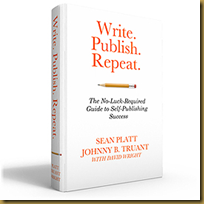
My current favourite, Write, Publish, Repeat (which I bought in audiobook, but have never sat down and read), alone must be over 100,000; it’s a monster (check out my review of Write Publish Repeat, plus my interview with its author, writer dad Sean Platt).  And it costs $5 all by itself. 

Again, the bundle is 88 cents. 

Get the deal here.

NOTE:  US-based viewers may see a price of 99 cents.  I wrote and published this post before I thought to check how it showed up here.  Here’s a screenshot of how the site comes through at my end:

image

(Which is funny, because usually we pay MORE outside the U.S.)

Let’s take a look at the math.

Write. Publish. Repeat., by Sean Platt and Johnny B. Truant Let's Get Digital, by David Gaughran How to Market a Book, by Joanna Penn

That’s at least $15 worth of ebooks, and these aren’t some second-run thing put out by fly-by-nights who don’t know what they’re doing.  These are the superstars of self-publishing, who have been at it for years and want to share their ideas with you..

I just bought the bundle, and I can’t wait until it comes out.  You should, too, even if you already own one (or two) of the books.  Here’s your last chance for this post…

Get the deal here.

If you do get it, or if any of these books have helped YOU, let me know in the Comments.

Friday, August 22, 2014

Two, (no, three!) heartwarming indie books.

from A Different Little Doggy, by Heather Whittaker

A lot of people send me books.

A lot.

But I don’t write a lot of reviews.  It turns out, I’m much too picky.

I know all too well that reviews are the lifeblood of any independent writer.  In theory, I’m happy to help.  But I won’t review just anything.  Like my mother always said, “if you don’t have anything good to say, don’t say anything at all.”

Two books arrived recently that were actually just right for us to read and review (check out my review guidelines before sending anything). 

Another is a series that has been waiting far too long, so I’ll throw it in here for good measure.

Here are the books:

I read the first two tonight, out loud, with my kids.  All of these books have a lot going for them.  It makes me excited to be an independent author, honestly it does.  It’s like the book says:  it was the best of times, it was the worst of times. 

These books are some of the best of what’s out there.

Sunday, August 17, 2014

Writer Dad: mini-interview with Sean Platt

image

Sometimes, it’s good to be backed into a corner.

Like us, staked out here at the corner of “writing kids’ books” and “self-publishing.” 

I live here, too.  And I love it.  I love sharing tools to create excellent children’s books, whether that’s tips on publishing, marketing, or actually sitting down and writing or editing the thing (and getting it illustrated).

Did I mention I have a guide coming out to self-editing your own children’s book?  I love every aspect of this process, even editing (and with this book, maybe you will, too).

But it does get lonely sometimes.

It’s a fun corner, but there aren’t a lot of us around.  We aren’t very high profile, and there aren’t many folks to keep us inspired.

image Then somebody like Sean Platt comes along, a proud indie author who makes his living and supports his family writing his heart out in science fiction, fantasy, nonfiction and more, to the tune of tens of thousands of words a week. 

Plus he does a couple of podcasts. 

Plus… (get ready for it)… he writes kids’ books.  But you’ve never seen his books, and he says you never will.  That’s because he writes under a pseudonym:  Guy Incognito, a name swiped from a Simpson’s episode.

“Most of my published work is for grownups, so it doesn't make sense for me to use the name ‘Sean Platt’ when writing for children.”

Sunday, August 10, 2014

Free-BEE! Free Kindle book on Amazon.com

image

My favourite price in the world:  free.  And my favourite thing in the world:  a kids’ book.  (Yes, one of mine.)

I don’t usually cross-post, but in this case, I’m making an exception so I can get the word out across all my sites:

Please Like, Share and pass along this deal.  FREE UNTIL AUGUST 14 ONLY!

Learn a little about Israel's modern history and its most beloved songwriter in this short kids' chapter book! This week (Aug 10-14), my book "Naomi Shemer: Teaching Israel to Sing" is FREE for Kindle.

CLICK HERE TO BUY THE KINDLE VERSION FREE UNTIL AUGUST 14.

I started writing this book when my daughter, named after Naomi Shemer, was a baby… but only finished it last year, when she was 8.  A long time in the making, but I think it’s worth every second.  (And I loved reading it to her and telling her about the amazing lady for whom she’s named.

Acclaimed in her lifetime as the "First Lady of Israeli Song" and the author of unforgettable classics like Jerusalem of Gold (Yerushalayim shel Zahav), Naomi Shemer is almost unknown in the English-speaking world. With its engaging, straighforward narrative, this book opens the world of Naomi Shemer for the first time to English-speaking children and their parents. Come find out what made her special.

(I'd also love to get some reviews up, so if you and your kids read/enjoy it, please leave an honest review to help others.)

Here are some shots from the paperback version of the book:


image image image

Enjoy!

CLICK HERE TO BUY THE KINDLE VERSION FREE UNTIL AUGUST 14.

Sign up for weekly writing tips (spam-free, guaranteed!)

* indicates required

Monday, July 28, 2014

The truth about celebrities… and their kids’ books.

Ball-playing, book-writing brothers Ronde and Tiki Barber.

Should celebrities write children’s books?

Whether we believe they should or not… that doesn’t seem to be stopping them.

Does the fact that they are rich and famous give them greater insight to children’s literature than the rest of us?


The celebrities… and their books

Peeking inside a few recent children’s books by celebrities, you can see that celebrity status doesn’t necessarily make for a talented or insightful writer… but it also doesn’t mean they’re not.

By My Brother's Side, by Ronde and Tiki Barber By My Brother’s Side by Ronde and Tiki Barber, illustrated by Barry Root 

This one gets a resounding “Like!”

This middle grade book, along with several others by the football-playing, kids’-book-writing brothers, is a great example of an encouraging children’s story by a celebrity, or in this case two celebrities.

Monday, July 21, 2014

How are your books selling? A $5 book that can turn sales around.

image

Do you have a head for business?

You should. 

If you’re a writer, of any kind, your business – like it or not – is writing.

It doesn’t matter if your books are full of butterflies, fairies, nymphs, talking animals and whimsy.  Once you’re done writing them, if you expect them to do anything other than just

image And the best guide I’ve seen so far to building a writing business is a hefty tome (479 pages) with the hefty title Write. Publish. Repeat. (The No-Luck-Required Guide to Self-Publishing Success).

With a thousand-dollar title like that, you’d expect to pay maybe $17 for this gem, but I just checked and the current Kindle price is $5.58.

Sometimes, as self-publishing children’s writers, we figure we’re somehow exempt from all the messy business-type stuff that applies to other self-pubbed writers today.

We’re not exempt.

As a self-publishing (or, as they say, indie) writer, you have to keep your head on your shoulders and focus on the 80% of activities that pull in the vast majority of profits.  Don’t worry; writing is one of them.  Stuff like piddling around with facebook and blogs (oops) might not be.

Wednesday, June 25, 2014

Writing with Pride: creating LGBTQ kids' books that don't make it an "issue."


Are you proud of who you are?

I hope so.

But as much as I wish I could say that pride was enough to create a great kids' book... it's not.  The last few years have seen a flood of LGBTQ-oriented kids' books rushed into print... not all of which are fantastic.

I want to say this up-front:  I am not LGBTQ, and I write this as a white woman married to a white man.  So some would say that we're uniquely privileged... and that members of a minority should take any opportunity they can get to show families like theirs.

I don't want to argue with that.  I want to believe, instead, that there's a way to do that that doesn't undermine the cause.  And that way is to write a great story, with characters that happen to be... well, whatever type of characters you want to depict.

Why pride isn't enough

Too many of these books, particularly the classic ones, focus on the central "issue" - that there are two mommies, two daddies, that somebody is transgendered, whatever it is.  And those kinds of books are not only generally tedious to read, but also don't appeal to children.

      
I have a mom and a mom... or a dad and a dad!

The message of these stories is usually pretty simple-minded:  yes, we're different, but we're happy and our lives are full of love.  It's certainly not an offensive message....but neither is it very interesting, or engaging to a child.

I wear a dress, even though I'm a boy!

Children, by nature, take most situations at face value.  It's us grown-ups who have trouble processing things that are new or different.  If a kid has two mommies, she knows it and doesn't usually love it or hate it - it just IS.  If somebody at school has a problem with that (probably not another kid; probably one of us closed-minded grown-ups), there are ways of reassuring kids without making a big deal out of it.

Another thing about "issues" books?  They get dated REALLY fast.

Books centred around the theme of overcoming intolerance and educating the general public are going to seem very, very odd in a decade or two when it's just Not a Thing (as my 18-year-old daughter would say).

Want to know the worst offense when it comes to "issues" books?

Sunday, June 15, 2014

Carnival of Jewish Books – June 2014 / Sivan 5774

Read, written or reviewed a great Jewish book lately?  These bloggers have! 

Welcome to the June / Sivan Carnival of Jewish Books, a monthly roundup of all things bookish in the Jewish blog world.  I’m going to quote one of the previous hosts here: 

If you blog about Jewish books, you can play too! Visit the Jewish Book Carnival HQ for info about submitting your links to upcoming carnivals.

Let’s hop on a magic carpet and take a tour of what’s happening in Jewish book blogging this month.

Saturday, June 14, 2014

TOBY Book Launch Blog Tour: mini-interview with author Stacy Nyikos

image

If you’re here for the book tour, come on in, make yourself at home… and come meet Stacy Nyikos, a writer who says she’s “hooked” on writing kids’ stories.

imageAs a children's writer, I get to create worlds as spongy and delicious as marshmallows, soar through green oceans with talking sharks, and float on misty air currents riding the backs of ancient dragons. It's an amazing place to live in. And it changes on a daily basis.

You can see why she’s had such success so far.

Stacy’s new book, Toby, illustrated by Shawn Sisneros (Stonehorse: 2014), is about the journey of a turtle hatchling, who emerges from his egg to find himself all alone.  Where are the other turtles?  Toby’s journey gently explores the often-perilous reality facing a solitary baby sea creature, but with fun verse that really works well with Shawn’s appealing illustrations.

As you’ll see, sea creatures are a bit of an obsession for Stacy, and with very good reason. 

Thursday, June 5, 2014

Meet Mark Collins! What he’s doing right, plus two book reviews.

image

Why share reviews on a blog about writing kids’ books?  Aren’t there a ton of great book-review blogs (not to mention professional publications reviewing books) out there already?

Yes and no.

Most publications, and even some of the blogs, won’t touch self-published children’s books.  They figure the world is flooded with self-published books, and most of them just aren’t any good (they’re not entirely wrong).

I see a ton of self-published kids’ books these days – most of which are not extraordinary (unless they’re extraordinarily bad). 

So when I come across somebody who’s doing a great job in every way – writing, illustrating, publishing, promotion – I feel like we ought to carve out a small space to highlight their accomplishments and see what they’re doing right because:

a) they deserve the kudos for doing something great, and

b) maybe we can all learn a thing or two.

Meet Mark C. Collins!

And Mark C. Collins is doing just that – writing terrific books that kids love (and testing them on his own kids).  It helps that he’s his own illustrator, too, with a bright, compelling style that – according to his bio – he’s been perfecting since age 2.  (Me, too, but my art is still a long way from being presentable.)

Two of Mark’s brand-new books,

Tuesday, May 27, 2014

15 Kindle books under $10 that will help you write a great children’s book… and 3 to skip at any price.

image
I read a lot of ebooks these days, because we’re about a bazillion miles from the nearest English-language bookstore.  And like always, I love reading… about writing.  But I don’t love spending a ton on writing books.  It makes writing feel like a self-indulgent hobby, an extravagance.  So I’m always on the lookout for cheap, high-quality writing books.
Happily, there are many good books out there for not much money.  But how can you sift through them all and decide which ones are worth even the little that they cost?  Here, I’ve sifted through the cheapest and best I could find to offer you fifteen good ones and three stinkers.

What do I look for in a writing book?

First, here’s what I don’t look for - a few pet peeves I try to avoid, including:
  • Generic cover with a typewriter or something writerly that screams, “I’m going to spend all my time turning out a series of a dozen books on writing books… instead of writing books myself.”  Shudder.
  • Puns that promise you “the write stuff” or any other pun-ishing approach to writing it “write.”  Groan.
  • Books that start by telling you that “some people” think kids’ books are super-easy to write.  We know, we know.  Don’t lead with this – it’s not news.  Blah.
  • Out-of-date books that are re-released for Kindle with no new content.  Ugh.


Different genres of writing books

Before you buy any book, make sure you know what you’re buying.  The book’s description should tell you clearly what type of book it is:
  • Is it a “basics” book that will give prompts and help you actually write the story?
  • Is it an “industry overview” book that explains the business of publishing?
  • Is it a “nuts and bolts” book that tells you how to get your book ready for a specific format, like Kindle?
  • Is it a “promotion” book that shows you how to market a book you’ve already written?

None of these is the WRONG answer, by the way.  You need different books at different points in your life and even different days of the week.  If you’re not sure from the description of the book, be very wary.  Read reviews to try to find out.  Click to see the preview.  If you’re still not clear on what you’re going to get out of the book… give up and try the next one on the list.

The books

So without further ado (dontcha hate when they say “without further adieu…”?), I now present… the books.  I know I promised cheap Kindle books in the headline.  But I’m going to do you an even bigger favour and divide these books up into three price ranges:  super-cheap (under $2), way cheap (under $7) and still pretty cheap (under $10).  Beyond that, the books here appear in no particular order.

Super-cheap (under $2)

image

#1… $1.99 How To Write a Children's Picture Book by Darcy Pattison (Nov 28, 2013).  A terrific value even at a few bucks more, you cannot go wrong with this detailed book, that gets into the real nitty gritty of the writing and publishing business.  I OWN THIS BOOK.
image

#2… $0.01 The Business of Writing for Children: An Award-Winning Author's Tips on  Writing Children's Books and Publishing by Aaron Shepard (Mar 25, 2014).  As of this writing, it costs only one cent, way less than what I paid (I think $0.99 or $1.00?).  Buy it!!!  I OWN THIS BOOK.
image

#3… $0.91 Formatting of Children's Books and Comics for the Kindle, by Charles Spender (November 13, 2012).  The Amazon page for this book now directs you to this site (5th book down in the list) to download a free (& totally legit) copy.  What a nice surprise!  With 35 mostly-positive reviews, and a price tag like this, what are you waiting for?  I OWN THIS BOOK (now).

Way cheap (under $7)

image

#4… $2.83 The Easy Way to Write Picture Books That Sell by Robyn Opie Parnell (Oct 20, 2013).  Not my favourite, because I didn’t really click with her writing style and the book was a little basic for me.  She’s very enthusiastic, though – if slightly redundant in her advice.  This one is high on confidence but low on technical details.  A great suggestion if you’re just starting out.  I OWN THIS BOOK.
image

#5… $4.99 The Children's Writer's Guide by Simon Rose (Sep 22, 2013).  This one also falls into the category of good books for beginners, dealing with issues like naming your characters, turning ideas into stories, making time to write, dealing with rejection (important!) and more.  For under $5, it’s like a writing course in easy portable ebook form.
image

#6… $4.59 A Self-Publisher's Companion: Expert Advice for Authors Who Want to Publish by Joel Friedlander (Mar 24, 2011).  The only non-kids’-book specific book you’ll find on this list (and similarly, the only non-kids’-book-related blog on my blogroll, for the same reason).  If you ever hope to self-publish, Friedlander won’t steer you wrong.  You’ll get an overview of the publishing industry and what has changed with the advent of ebooks, as well as crucial lists of what self-publishers do wrong and how to fix them.  True, a lot of the pieces are available free on his blog, but come on - $5?  And most have been expertly revised to suit the book form and flow from chapter to chapter.  I OWN THIS BOOK.
image

#7… $2.87 Picture Books: The Write Way by Laura Salas and Lisa Bullard (November 13, 2013).  Recommended despite the “write” pun in the title.  This book deals with ten BIG problems that writers encounter when their stories meet up with editors for the first time.  It assumes you have a story that is already written and goes through this list of ten biggies step by step.  I love a book this focused and on-task, and as a result, this book is now ON MY WISH LIST.
image

#8… $6.28 Writing Magic: Creating Stories That Fly by Gail Carson Levine (August 27, 2013).  You don’t get much more cred than Levine, creator of such books as Ella Enchanted.  Mainly geared towards teaching middle-schoolers how to write, this book has clearly struck a chord with adult writers as well, judging from its positive reviews.  If you consider yourself an expert or advanced writer, this may not be the book for you given its young adult focus.
image

#9… $3.67 The Busy Writer's Tips on Writing for Children by Marg McAlister (November 22, 2012).  Another one I’d never heard of.  Amazon says the writer, Marg McAlister, has written more than 60 books for children – which may be, but not a single one is listed on Amazon; all they have is her books on writing for writers.  But she’s in Australia, which may explain this, and her own website, writing course, etc., look legit.

Still pretty cheap (under $10)

image

#10… $7.62 How to Write a Children's Picture Book and Get it Published by Andrea Shavick (July 29, 2011).  I admit, I hadn’t heard of Shavick or her book, but it looks well written enough, and her personal website is professionally done, which tells me that some effort has probably gone into the book as well.  If that sounds like it’s setting the bar pretty low, you should see some of the so-called writing books out there.
image

#11… $9.38 Writing Irresistible Kidlit: The Ultimate Guide to Crafting Fiction for Young Adult and Middle Grade Readers by Mary Kole (Nov 6, 2012).  I love it when bloggers write books!  You can check out their writing and the quality of their advice for free ahead of time.  Mary Kole is a pro in both areas, and this book is ON MY WISHLIST.
image

#12… $9.17 You Can Write Children's Books by Tracey E. Dils (Sep 10, 2009).  Another one that was new to me, but what an encouraging title.  Lots of great reviews, too, showing that this is a beginner’s guide that may be worth the (under $10) investment just to have on the (virtual) bookshelf.  While I haven’t read this book specifically, the Kindle edition is an update of an earlier book published by Writer’s Digest, so I expect that it is well-produced, slick and upbeat, like most of their other books… a format that was very, very encouraging to me when I was just starting out.
image

#13… $9.18 The Everything Guide To Writing Children's Books by Lesley Bolton (Dec 1, 2002).  Looks like a solid overview from this company, that publishes “For Dummies” style intro books, and offers a glimpse of the process of creating kids’ books.  Most of the focus is on traditional publishing, with only a brief, discouraging (and perhaps slightly outdated) nod towards self-publishing.
image

#14… $9.17 The Nuts and Bolts Guide to Writing Picture Books by Linda Ashman (September 25, 2013).  With a ton of published kids’ books under her belt, Linda Ashman feels like a writer you can trust.  Plus, blogger Julie Hedlund says it’s full of “juicy goodness”… how can we resist?
image

#15… Okay, at $10.15, How to Promote Your Children's Book: Tips, Tricks, and Secrets to Create a Bestseller, by Katie Davis (March 22, 2014), is slightly over the promised price point (but then I gave you one free, so go easy on me).  This is one I haven’t read, but it’s on my wish list now for sure.  With 151 positive reviews (in just over a month?!), this book about a much-overlooked area is what I’d call an Important Read.  How about this positive review from Laura Purdie Salas, co-author of Picture Books: The Write Way (see above):  “I blog, Facebook, and do a lot of promotional stuff, including an online book launch, online teacher extension materials, etc. But Katie's book still offered me tons more ideas for things I want to check out”?  Come on… it’s only $0.15 over!  ON MY WISH LIST.

…And 3 to skip unless they’re free

(and even then, probably skip them)

Why avoid these books?  Even a cheap book isn’t free if you think about the time you have to put in reading it.  Why throw your money away on a book that offers you cheap information that you can find either on the writer’s blog or, worse, on someone else’s – because they’ve just ripped it off and/or spun it to create their book.
image

#1… $4.71 Publish Children's Books - How to Self Publish and Market Your Kids Books by Caterina Christakos (Sep 1, 2013).  See that image of money bags on the cover???  Yeah, that’s you, raking in the dough over your little rhyming nursery story – NOT.  What a weird cover.  At only 18 pages, this is way too short to call a book.  A pamphlet, maybe?  Just from the preview, I can tell that the writer has no clue how to use a comma, and she uses every opportunity to hype her own book, How to Write a Children’s Book in 30 Days or Less! – which, by the way, has many bad reviews and is apparently full of typos.  Her only children’s book visible on Amazon begins with the sentence, “In every baby’s life, their comes the time when they get to meet their very own guardian Angel.”  Groan…
image

#2…$1.00 Writing Guide: RIGHT FOR KIDS: 333 One Sentence Tips and Tricks on the Art and Business of Writing Picture Books for Children by Tom Skinner (June 29, 2012).  This book is chock full of three hundred and thirty-three one-liners like, “The industry is very competitive and full of talented professionals,” “You can do it!  (With a few tips + bit of study + practice),” and “A picture book is simple.  And simply irresistible.”  Guess whose book I’m resisting very easily right now?  Pretty easy to avoid given that he has a chapter called “COZ HE WOZ.”
image

#3… $2.88 Writing Books for Children and Youth (Boot Camp for Christian Writers) by Carolyn Tomlin (Dec 19, 2013).  It’s not the religious aspect of this book that turned me off.  It’s the near-illiteracy of its sweeping generalizations (“There are some writers who look at trends – including what topics are being discussed in the media?” “Writers for children’s books would be wise to know the breakdown of the publisher you wish to submit your work”), and the lack of writing cred of the author.  Despite this lack, she offers copious examples – including a full-text excerpt – from her own single children’s book (“Matthew smiled when he thought about all of his different friends.  They all looked different from him.  Some had dark skin, others light.” Can you tell yet that the book is about multiculturalism??  In case you missed it, how about, “On the next block lived Matthew’s African American friend, Lakesia.”?).  And in case you’re looking for a Christian perspective, I couldn’t find any in this book except in the aforementioned excerpt.

*All prices are as of this writing.  Amazon pricing can fluctuate randomly from day to day and even from minute to minute.

Did I forget to include your favourite book?  Let me know in the comments!