Showing posts with label happy. Show all posts

Tuesday, November 21, 2017

Finishing your book–the “nibbled to death” way

image

I'm working on a book.  I've been at it for a while, in fact.  Years.  And guess what?  I'm on page 11 already!

So... okay. 

Go on. 

Say it to my face - exactly what you're thinking.

Which is probably something like, "That's not much for years of work."

"Page 11?  That's not very good."

"Eleven pages?  I could do better than that."

"A turtle could do better than that."

Yes, it's true.  Page 11 is not very far into a book.  It's going to take a loooong time to finish.  A year, to be exact.

But I will finish, I do know that.  And in a year, I will have a book under my belt.

When I started looking for images to use as the heading for this post, I was thinking seriously about a turtle, because a turtle is a great symbol for slow and steady winning the race.  We all recognize this guy from the Aesop’s Fable story, right? 

image

Yeah, yeah, turtles.

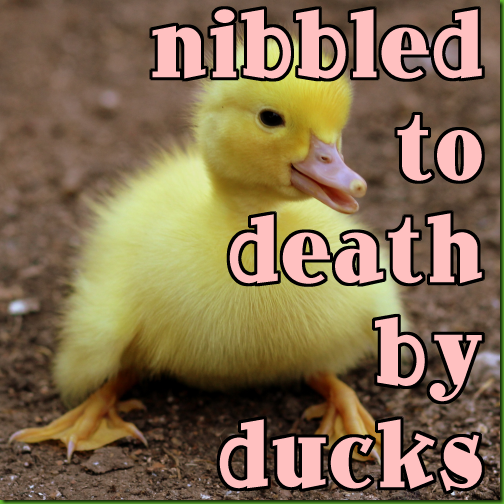
But really, a better image is ducks.  This guy:

image

There’s an expression I hadn’t heard before a few years ago, and it sums up my strategy for getting this book DONE, and that is:  "Nibbled to death by ducks." 

What does it mean?  Well, look at that duck.  He's pretty cute, right?  That beak totally doesn’t mean business.  He looks like a lightweight for sure.  If you let him nibble at you, he wouldn’t do much damage.  Unless he kept nibbling.  Just kept nibbling and nibbling and nibbling…

Well, okay, that’s getting a little gross.  My point being, one nibble by one duck doesn’t do much damage, but

Sunday, October 22, 2017

How to write more productively - by writing slower

image

Trying to figure out how to write faster?  Maybe you need to slow down.

I know, I know... that probably feels like the exact OPPOSITE of the advice you're looking for.

But maybe you've heard about the SLOW trend?
It's epitomized by the Slow Food movement, but in general it's a trend towards handmade, artisanal, more authentic living.

Last week, I sent out an email to friends on my list (join me by signing up at the bottom of this post!) with a call for YOU to tell me your biggest writing challenges. 

One writer wrote back that he struggles with writing regularly.  Not that he can't get what he calls his “butt in the chair,” but that he senses that writing at the computer is not as efficient as it's cracked up to be.  On the other hand, he said, any other approach (I guess this means writing by hand, but perhaps also dictation), means writing twice as much as necessary.

I can relate.  But still - I want to address two things:

  1. Yes, the computer is not terribly efficient unless you're one of these super-disciplined people who shuts down every background app, turns off your phone, maybe blasts some music, and writes non-stop for a timed session.  If you do, kudos to you.  Most of us can't do that.
  2. Writing by hand doesn't HAVE to be inefficient.

That’s what I want to talk about in this post.  How despite my love for writing on the computer – which I’m doing this second as I craft this post - I have also discovered the joy of writing by hand. 

Don’t worry, I won’t try to turn you into a luddite who shuns computers altogether (like I said, here I am!), but I do want you to start thinking of your hand as yet another writing tool, one which can help you write better and even (gasp!) more productively.

Hand writing as a discipline

Here’s how I was sold on the value of hand writing.

I haven't really mentioned here, but I'm 8/11ths of the way through a master's degree in Writing and New Media which I started in 2016 (yay, me!) and as part of that, I had to do a course in "developmental writing."  That means therapeutic writing, writing for personal development, writing as therapy, whatever you want to call it.

To pass that course, I had to take on a 3x/weekly practice of writing by hand for 20-minute sessions with a candle, a timer, and a playlist of baroque cello music by Yo Yo Ma. 

I wish I was joking.

You have to understand how hard this was for me.  I type somewhere between

Sunday, October 8, 2017

How to create home-run stories with a perfect pitch sentence

image

I’ve talked before about the importance of the “pitch.”  This is a single sentence you can haul out whenever anyone asks you to describe your book.  Here, I’m going to give you my secret “formula” for creating awesome and compelling pitch sentences.

But first – why do you need a pitch?

  • For talking to agents or editors, if you ever get a face-to-face meeting
  • For including in your cover letter
  • For chatting with friends and other children’s writers
  • For writing your back-cover synopsis if you’re self-publishing

Most importantly, though, the pitch helps YOU. 

If you can’t sum up your picture book in a single sentence, you’re either trying to cram too much into your story, or you don’t have a clear enough idea what it’s about.

So here’s my secret formula – and it’s actually

Thursday, July 27, 2017

If you want to write kids’ books–read, read, READ! (with 6 of this summer's favourites)

image

What’s the best way to ensure that you’re writing kids’ books that are relevant to today’s readers? 

When I say readers, by the way, you can assume I also mean all the gatekeepers between you and your readers: editors, agents, publishers, and anyone else who gets to vet your book before it’s approved for publication.

And the best way to make sure you’re writing the books they want to see is… to READ kids’ books.  A LOT of kids’ books.

Now – just to be very, very clear here, I’m not telling you a) to read books in order to copy them, or b) to read books in order to write more marketable books.  You probably shouldn’t be thinking about marketability as you’re actually writing your book.

But reading what’s out there on the children’s-book shelves will give you an edge in a few ways, by helping you answer the following questions for yourself:

  • Who are the protagonists of kids’ books today?
  • What kind of situations do they find themselves in?
  • What’s the art like?
  • How wordy are they?  (hint: not very!!!)
  • What kind of vocabulary do they use?
  • What kinds of resolutions / messages do publishers seem to prefer?

Now, if you’re like me and you live in a non-English speaking country, all of this puts you at a distinct disadvantage.  And even if you live in a totally English-speaking country, there are a few reasons you might not have visited your local bookstore or library lately. 

For example, many children’s authors are older parents or grandparents – you may have read a lot of kids’ books at one point, like when your kids were younger.  You just haven’t checked out new books recently.  But why should you bother?  Classics are classics are classics, and what makes a book great doesn’t change from one generation to the next… right?

WRONG.

Even when it’s difficult, you must check out what kids’ books are out there, not just to scope out the competition but to make your own stories stronger and more contemporary-feeling.

Here’s one tip that I sent around to my local SCBWI chapter a few months ago:  search for current popular kids’ books on YouTube.  We had just had a Skype meeting with a publisher in L.A., so everybody was fired up about writing books for a U.S. audience, but many people in the crowd weren’t really sure what that entailed. 

Fortunately, there are MANY popular kids' books being read aloud by native English speakers on YouTube, including many of the books the agent had placed on her recommended-reading list for authors submitting to her. 

Wondering what books she suggested???  Here are the two books she mentioned most:  Llama Llama Misses Mama (https://www.youtube.com/watch?v=9xB6i1ReuT8) (along with all the other Llama Llama books by Anna Dewdney!) and Dragons Love Tacos (https://www.youtube.com/watch?v=AUTmRJqwI_c).  I'm betting that whoever can write the next book like those will get a sweet deal from her publishing company!

I’m very lucky to be in Toronto visiting family right now, so I took this opportunity to walk into my local library last week to scope out (aka “take home half of”) the kids’ picture-book section. 

Here’s my haul:

image

These are all fairly recent.  I’d heard of two of these beforehand and was psyched to see them in stock:  School’s First Day of School by Adam Rex, and Yaffa and Fatima: Shalom, Salaam by Fawzia Gilani-Williams, from Kar-Ben, the same publishing company that published my book Yossi & the Monkeys.

The first of these, School’s First Day of School, has been on my wish list

Thursday, May 4, 2017

Be grateful for editors!

image

Yesterday, I got the phone call I was dreading – a call from my EDITOR.  I spent half an hour on the phone yesterday with the person in charge of editing my next children’s book, and I have to admit, I had been dreading her call for a while.

I got an email from her when the book was first accepted by the publisher (yay – details to come, I promise!) saying, basically, “We love your book, but naturally, we’re going to have to make some changes to the text.”  Which is their prerogative, right?  I can’t force them to publish my book as-is, no matter how much I love the text, so my best bet if I want to be published is to roll with things.

So.  I was prepared to roll with things.  But that doesn’t mean I was looking forward to her call, in which we would “discuss the changes.”

Ugh.  Did she not realize how much I’d sweated over every single word of that story?  Written, revised, erased, gotten it to the point where it was just about perfect?

Let me tell you – I didn’t feel particularly grateful about the spectre of her call.

When you read a commercially-published book, you’ll often see a bit at the beginning or the end where the author thanks her family, her agent, and then her editor (or editors).  I always took that part for granted until I started working as a novice journalist and working with editors who actually hacked and slashed and carved up my writing to find the most important points within it and bring those to the fore. 

And at first, dealing with those editors, what I felt was mostly ingratitude.  How dare they tell me how to write?  Isn’t writing supposed to be an art form?  And if so, would they swipe their red pens across a Degas or Van Gogh if they didn’t like what they saw on the canvas?

I was being – feel free to slap me now – frankly ridiculous.

Oh, I was gracious enough.  I wanted to keep making money and getting published, so I rolled with it, like I said, and even said “thank you.”  But I wasn’t feeling it.  Oh, boy, was I not.

But gradually,

Thursday, August 25, 2016

Duckies, dragons, dinos: how old is your reader?

image

Can you tell the difference between a three-year-old and a ten-year-old?

I’m guessing you answered yes to that question.  But do you ask yourself this question when you sit down to write a picture book?  When you’re writing the thing, of course, it’s most important to follow your inspiration and get the words down on the page (screen!). 

But once you’re ready to think about submitting it or publishing it yourself, it’s a different story.  THEN you have to start thinking about audience.

Somebody got in touch the other day to chat about a kids’ book project and he happened to mention that the book was aimed at “kids ages three to eleven.”

Three to eleven???

Monday, July 13, 2015

Forever young: 20 famous children’s authors still working hard after 65

image

Years ago, the age of 60 marked a threshold in a person’s life.  Not anymore.  Today, 60 is just the beginning.  For many authors, including independent, self-publishing authors, it’s the start of the most productive years of their career.

Why?

Easy:  we’re busy doing other things.  If you start having a family in your 30s, then you’ll be in your late 50s before they’re all up and out (if you’re lucky).  Plus, until age 60ish, you’re probably working like crazy and perhaps caring for elderly relatives as well.

It’s a tough time to sit down and write a book (though you can still find time to write if that’s where you are in life!).

An ancient Jewish teaching says that “at fifty, one can give counsel; at sixty, one attains old age, and at seventy, fullness of years.”  This is because King David died at 70, which the Book of Chronicles (29:28) says, “And David died at a full old age.”

Forget about that.

Monday, July 6, 2015

3 ridiculously easy ways to get more words down on paper (a guest post)

image

We’re heading overseas for our big family vacation in Canada, so I’m turning over the rudder to the experienced hands of Australian writer Ruth Barringham, who’s here to talk about…

3 Ridiculously Easy Steps to Writing More

imageWe all have the same amount of hours in a day and it's usually not possible to complete everything on our daily to do list.

This is especially true when it comes to writing because not only is it something that we put off doing to last every day, but find it hard to concentrate because of the nagging feeling that we should be doing something else.

But what if you could sit down and write every day with 100% focus on your work and write more in the same time?

Is that something that you like to do?

Friday, June 26, 2015

How to have fun collaborating on a kids' book–with a kid

image

Hand in hand in hand in hand.  Collaborating on a meaningful book project together – why not?

The image is so beautiful.  Jodi Picoult writes with her daughter.  So maybe you’re wondering:  why can’t you write a children’s book with your son, niece, granddaughter, cousin, or any other kid you happen to have nearby?

image

(Jodi Picoult and her daughter, Samantha Van Leer, who have written two books together.)

The answer is a resounding yes.  YES!  Absolutely, you can.  You can write a book together, and have tons fun doing it.  Sure, you’ll both learn a lot, too, but shh… keep that part under wraps.  You don’t want it to seem too educational.

Kids adore making books.  More than just another boring creative writing project, they sense that by creating a book, they’re onto something important.  They’re bringing something wonderful into the world.  And you know what?  They’re right.

Follow these DO’s and DON’Ts to make sure you’re not disappointed, and that you both have fun from start to finish.

DO pick realistic goals ahead of time.

What’s your definition of success?  Be honest.  Pick a definition you can both agree on. 

Thursday, June 11, 2015

5 survival tips for the long, uphill journey to a finished book.

image

You’re standing at the foot of a mountain.  Don’t look up, or you’re done for – there’s just so far to climb when you’re just starting out.

I started a new nonfiction book this week.  I love writing them, gathering photos, putting the information together.  But it’s soooo much work.

Short picture books come easily, but longer stories, like chapter books, are an uphill slog.  Some chapters in a longer book are fun to write – others, not so much.  And when I’m right at the beginning… well, some days I feel like I don’t have the strength.

Does that happen to you, too?

Here are some ideas that get me up that mountain.  I’d love to hear yours, just leave them in the comments at the end of this post.

1.  Sit down and write

“Writing is a struggle against silence.”
― Carlos Fuentes

Writer Cory Doctorow says, “Write every day. Anything you do every day gets easier. If you’re insanely busy, make the amount that you write every day small (100 words? 250 words?) but do it every day.” (read more here)

Monday, June 8, 2015

The seriously YOLO guide for children’s book writers and other grown-ups.

image

If you were around the Internet a couple of years ago, you probably came across the sleazy wad of letters that is “YOLO.”

It stands for “You Only Live Once,” and it’s basically an updated take on “carpe diem.”  Kids essentially used it to justify doing crazy and impulsive things in the name of enjoying their one and only go-round on this earth. 

But maybe you’re wondering how it can help us, as writers, and grownups, who are not so impulsive.

Even now, a few years after its heyday, the #YOLO hashtag is still alive and well on Twitter:

and and


Basically, if you see the YOLO hashtag, you’ll know the person’s doing something you probably wouldn’t do.

But why should teenagers have all the fun, and keep what’s actually kind of a great meme all to themselves?  Let’s take YOLO back and claim it for children’s authors everywhere. 

How can YOU channel the “spirit of YOLO” to help yourself succeed as a writer? 

Thursday, May 21, 2015

Are your books too babyish? The grown-up way to write kids’ books, with 3 easy fixes.

image

Writing for kids keeps us young at heart.  How great is that?

(Very!!!!)

But maybe you’ve made the mistake of thinking that “young at heart” means writing in a childish way.  Are you underestimating your readers’ intelligence?  Is your children's book TOO childlike? 

Sure, we’re writing for kids.  Sure, I feel like a kid when I write.  But we shouldn’t make the mistake of creating books that sound like they’re written by kids – or worse, babies. 

Here are three common problems, and quick fixes to make sure you don’t fall into these traps.

1.  Baby talk

Language development experts say parents should try to speak normally to even the youngest kids.  Some “goo goo” is fine if we’re playing around, but when you’re talking to a baby, you should make an effort to use real words.

Same thing if you’re writing for kids, even babies.  Use real words.  A grown-up is going to be reading the story, so you don’t have to worry that your words are too hard for kids to read.

And whatever you do, don’t make spelling or grammar mistakes – especially on purpose.  Don’t spell fruit as “froot” just because you think it will appeal to kids, or emphasize how hard something was by spelling it “harrrrrrd.” 

Would writers REALLY do this?  I assure you, they would.  I’ve seen some horrors out there.  But you’re the one I care about: don’t you do it.

Sunday, April 26, 2015

How to be a bolder, more confident writer (hint: don’t baby your book!)

image

Once upon a time (don’t worry; this is a true story), when my older kids were little, my dad took them out to the park.  I came along after a while and saw he was pushing my son alarmingly high on the swing. 

“Daddy,” I said, completely on edge, “that’s WAY too high.”

“That’s okay,” he said.  “You can always make more.”

In that moment, a) I knew he was going to ruin my son’s life by pushing him too high, and b) my father knew it was perfectly safe and I was being a silly first-time mom (albeit one with two kids, but it was still early days).

(The fact that I did indeed go on to make two more kids is irrelevant.  My father knew nothing bad would happen.)

That’s how it is with your first book, too.

Getting over the apprehension

You need to get over it.  Just as I did with my new-mom apprehension.

When I put out my first children’s book, I really cared about every aspect of it.  I laid it out as well as I knew how at the time.  I threw myself entirely into editing and the cover.  (Those things are as it should be.  I hope you do them as well.)

But

Monday, March 30, 2015

Illustrating your kids’ book on a shoestring budget: YES, you can! (here’s how)

image

Your book is perfect… now, do you know where are the pictures are coming from?

The other day at my SCBWI meeting (have you joined yet?), I mentioned my easy technique for creating a Kindle book from Microsoft Word, and I said, “you just take the words and pictures and pull them together in Microsoft Word.”  To which someone asked, “yeah, but where do the pictures come from???”

Everybody’s ears perked up.  Where DO the pictures come from?

You see, most of us are writers, not illustrators.  Some of us couldn’t even draw stick figures, even if our lives depended on it.

If you write AND draw, you’re lucky.  For most of us, writing is easy… and drawing our own pictures is an impossible dream.

But don’t worry – that doesn’t mean you’re stuck!  Here are three affordable ways (from cheapest to most expensive) that I’ve managed to get great pictures for my own books at prices that didn’t bankrupt me (yet):

1) Super-cheap:  Stock illustrations & photos

I told you a couple of weeks ago about how I get stock photos and illustrations for only $1 apiece… and sometimes, even less.  I really recommend you check it out.

Not every book is the right fit for stock photos, but sometimes, they can add a lot of fun to a story.  I’ve written a series of Jewish holiday children’s books illustrated with stock photos of animals.

Wednesday, February 4, 2015

55 juicy story starters to light up your story the campfire way

image

Stuck for inspiration?  Try writing your story the campfire way.

Have you ever built a campfire?

Maybe you know the trick already:  you don’t start by taking huge logs and setting them ablaze.  That would never work. 

You start with tinder, small fluffy things that are nothing like the fire you want to create.  From tinder, you work your way up to kindling - bigger things that also catch fire easily.  Once you’ve got some momentum going, THEN (and only then) can you start burning the real stuff:  twigs, and eventually, small branches, and only then… are you ready to set fire to some logs.

That’s how stories work, too.  Even if you want to write a HUGE story, you have to start small.

There are so many big ideas out there, waiting to be written down, that it can seem overwhelming.  So don’t set out to write about the BIG ideas.  Small ideas – whether from your own imagination or from story starters like these – are the tinder that will set your story ablaze. 

That’s where these 55 story starters listed here come in.  These 55 small ideas can help you set fire to millions of stories… if you let them.

Read through the lists.  If one or two don’t click, just move on.  If you get to the end of the list and you haven’t found one… I’ll give you a list of random generators for millions more ideas that just might inspire you instead.

Deal?

Let’s get sparking those stories!

Wednesday, January 21, 2015

Do you know about the FREE Children’s Story Magic writing course?

New session begins February 1st!

Here's what you'll get, in 30 days:

  • Character - creating heroes and villains that we'll love
  • Wonderful words - choosing and using the best nouns, verbs, adjective and more
  • Dialogue - tools to put words in your characters' mouths
  • Plot - crafting a story that keeps us on our toes

Each day's email is a tasty, bite-sized 100 words long.  That’s super-short, because I know you’re super-busy. 

Every day, you’ll be challenged, through examples and exercises, to think about successful kids’ books… and about your own.  Let’s get YOUR book off your hard drive and into kids’ hands sooner than you could ever have dreamed.

Sunday, January 4, 2015

Best of the Indie Children’s Book Covers – new contest for 2015!

image

2015 CONTEST NOW OPEN!

(FOR BOOKS PUBLISHED BETWEEN DECEMBER 1, 2014 AND NOVEMBER 30, 2015)

When it comes to marketing your self-published book, your cover is everything.  It’s a flyer, a billboard, a trailer, all rolled into one… and it has to be just as compelling in its teeny tiny thumbnail version.

I was so excited about my Top 19 indie kids’ book covers that I decided to do it even bigger and better for 2015.  Watch this space for details in the months to come.  Literally, this space.  Bookmark it and come back, as I will be updating this post once I know more.

To make this more about “great design” and less about “my opinion,” I’m bringing 3 other people on board to help judge the entries.  I’ll also figure out a couple of great prizes (beyond exposure), for books we all absolutely love – probably the Top 5 entries. 

(I will present the Top 20 entries on my site, with judges’ comments and links.)

Who’s Judging?

What are the prizes???

This is my first year doing this – hopefully, the first of many! – so I’m still rustling up some great prize ideas.  I hope they’ll include a blog tour (on relevant blogs) and book-related services.  Be sure to check back soon for more details!

Contest entry rules: 

Friday, January 2, 2015

Why give your books away for free?

image

How do you feel about freebies?

When I posted  about how I use KDP Freebies, I got some very intense reactions.  Some people were angry that readers have come to expect freebies, others mystified – wondering why writers would bother to offer them.  One response was sort of a cross between the two:  angry AND mystified.

Nothing's free in this world, so why should our product be free?

That’s what this person asked, and in a way, I totally agree with what I think she’s trying to say.  We work hard to write our stuff.  And we want to make money writing.  So how does it help us to give it away for free?

Tuesday, December 9, 2014

12 nights of Chanukah fun: a mega Jewish holiday picture book roundup

image

Before you read any further, you should know:  these aren’t exactly reviews.  They’re BETTER.

(That’s also why I want you to read this even if you don’t celebrate Chanukah.)

What could be better than reviews?

As writers, we’re at work even when we read for fun (even when we read to our kids), and that’s a serious job.  We have to examine each book not simply for whether or not we enjoyed it (like ordinary readers do), but analyzing it to figure out IF it works and HOW it works.

That’s the only way we can make our own writing better.

Working while we read (for pleasure)

When I took a children’s picture-book writing course earlier this year, I had to research “comps” – comparable books on a similar topic.  Since I was working on one of my Chanukah books, I decided to research what else was out there in the world of Chanukah books.  I chose these books almost at random, but I think it’s a good assortment of what’s out there.

Have fun reading through them, and hopefully discovering a few new favourites. 

  • How Do Dinosaurs Say Happy Chanukah? by Jane Yolen, illustrated by Mark Teague
  • Mrs. Greenberg's Messy Hanukkah, by Linda Glasser, illustrated by Nancy Cote
  • Esther’s Hanukkah Disaster, by Jane Sutton, illustrated by Andy Rowland
  • Chanukah Lights, by Michael J. Rosen, illustrated by Robert Sabuda
  • Latkes, Latkes, Good to Eat: A Chanukah Story, written and illustrated by Naomi Howland
  • The Story of Hanukkah, by David A. Adler, illustrated by Jill Weber
  • Sammy Spider's First Hanukkah, by Sylvia A. Rouss, illustrated by Katherine Janus Kahn
  • Biscuit's Hanukkah, by Alyssa Satin Capucilli, illustrated by Pat Schories
  • Elmo’s Little Dreidel, by Naomi Kleinberg, illustrated by Christopher Moroney
  • Light The Lights! A Story About Celebrating Hanukkah And Christmas, by Margaret Moorman
  • Engineer Ari and the Hanukkah Mishap, by Deborah Bodin Cohen, illustrated by Shahar Kober
  • Battle for Torah: The Message of Hanukkah, by Kay Kindall, illustrated by Neil Kindall

While you’re reading through these short blurbs, take a look at some of the different ways we – as writers –should be analyzing “comps.”

What to look for

Sunday, December 7, 2014

15 gifts writers will scream for: the essential 2015 Write Kids’ Books gift guide.

image

You’re here because you’re a writer or know a writer, or both.  Either you’re looking for the perfect gift that will draw gasps of delight or screams of satisfaction (is that even a thing?), or you’re hoping to pamper yourself in the middle of this season of selflessness.

Either way, here are 15 great ways to give yourself permission to go for it.

1) Paperback room fragrance / cologne by Demeter

image If you haven’t tried Demeter perfumes, colognes and fragrances, you should.  They’re mindblowingly “real” scents in varieties you’ve never imagined:  Tomato, say, or Dirt, or Thunderstorm.  They all smell great.  Years and years ago, I got a bottle of their gin and tonic scent, and I loved it almost to death.  I still have the bottle, which I refuse to use up.  I sniff it from time to time when I need a pick-me-up.  But what could be a better pick-me-up for a writer in need of inspiration?  Available as a home atmosphere spray – to get you in the writing mood! – or as a cologne.  (The bottles look similar; make sure you choose the one you want.)

2)  Flying wish paper

image Write your heart out, then set it on fire.  Send your dreams upwards.  Hopefully you’ll wish for inspiration, and be rewarded with tons of great ideas and incredible words (that you won’t want to burn).

3) SimplyRain

imageBetter than background music when you’re trying to write.