Showing posts with label ethnic. Show all posts

Tuesday, May 12, 2015

Character names that fly - or flop: 5 rules to live (or die) by when you’re writing children’s books

image

What should you name your characters?  As much as we writers might like to think that story is all about plot, usually it comes down to character instead.  This is especially true in a children's book, when you sometimes have less than 500 words to impress your reader. 

Olivia, by Ian Falconer Have you met Ian Falconer's spunky pig Olivia

Would she have been just as quirky and charismatic with a name like Patty Pig?

You'll want to avoid these 5 critical mistakes to make sure you're creating a character kids can get into.  Without a character we love, the greatest plot in the world is worthless.

1.  Avoid alliteration

Patty Pig, Danny Dog, Ronald Robot, Big Bad Bertha, Eddie the Engine... with very few exceptions, alliterative names are terrible names, and editors tend to cringe when they see them.  If there's one thing that's the mark of an amateur, this is it.

2.  Don’t fear strange, ethnic or regional names

image Remember the story of Tikki Tikki Tembo-no Sa Rembo-chari Bari Ruchi-pip Peri Pembo?  Certainly, if you have read it, you'll never forget his name!
That said, check to make sure the name you're using is authentic.  Tikki Tikki Tembo author Arlene Mosel neglected to do this, whether intentionally or not.  There is no such Chinese name, and apparently, many other "Chinese" details in the story are actually Japanese.  The tale itself may come from a Japanese folktale.

Thursday, May 1, 2014

Why “write what you know” produces terrible books: putting a spin on reality.

clouds wtihin cloudsSome of the lamest writing advice is “write what you know.”  It’s lame because it doesn’t go far enough.  It doesn’t show you how to take what you know and make it exotic, exciting, delicious and fun.

These advice-givers fear that, like Shakespeare, we will set our stories in some exotic locale like Denmark or Venice (where Shakespeare himself never actually visited). That used to be acceptable, back when travel was rare and you might never meet an English-speaking person who had visited “darkest Africa.”  These days, when you can hop on a plane and be anywhere, and back in a week to tell the tale, you can’t just make it up.

Fair enough. I think we all have this urge to make our writing exotic and interesting. Indeed, we may even confuse ourselves into believing they are one and the same.

Why?

Because most of us lead lives that FEEL as boring as paste.

We get up, go to work, take our children to soccer practice or dance class… and when we get home and sit down to write, we think, “why would anybody want to read about all of this?”

So we spice it up a bit, in an unnatural way: set our story in a more interesting city or make the characters wildly different from ourselves. Before we know it, we have written a terrible story about people we don’t know or understand.

Friday, April 18, 2014

Writing to change the world.

imageWhile I’m off enjoying Passover with my family, here’s another guest post, this one by an anonymous mom with strong feelings about the future direction of children’s books. :-)

In the past several years especially, the realm of children’s literature has made leaps and bounds in terms of diversity and promoting coexistence amongst our differences. But there are still topics that could certainly see a little more circulation in terms of popular children and adolescent publications, particularly when it comes to truly teaching youngsters about the dissimilarities of society.

Which of these do you think you could write about – and make a difference in kids’ lives?  (not to mention the world!)

Disabilities

Although picture books are not limited in portraying characters that need to use a wheelchair or crutches, few venture further into the territories of physical, emotional, or intellectual disabilities.

Sunday, March 23, 2014

Seven picture books that heal the diversity gap.

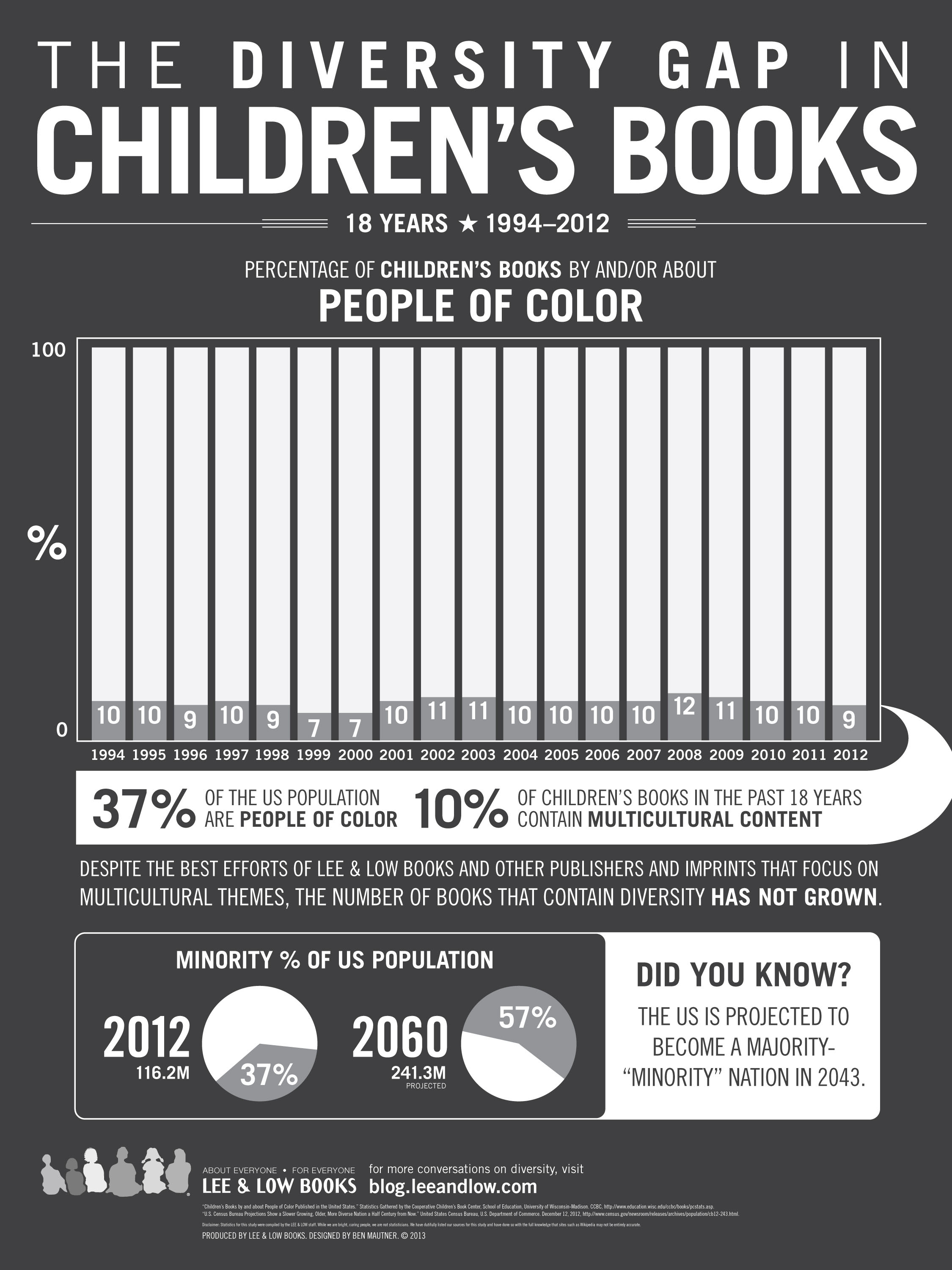
http://www.leeandlow.com/images/Childrens_Book_Infographic-lg.jpgLee & Low Publishers reports that the “diversity gap” in kids’ books hasn’t changed in the last 18 years – even though 37% of the U.S. population now comprises people of colour (a term I don’t like because it includes purple and cyan, but there you go). 

Pale-skinned people like me are slated to become a minority by 2060, yet up to 91% of kids’ books today are about people roughly the same shade as me & my family. 

This isn’t good for anyone – especially whitish folks like my kids, who look up from their reading to see a nation far more diverse than anything they see in books.

(True, we live in Israel, not the U.S., but yeah, it’s far more ethnically diverse than anything you might picture!)

The solution isn’t stocking up on books about black kids, written by black writers.  Change will only come when our shelves are stocked with TRUE diversity, books that reflect the true cultural context of our lives.  Books by every-colour authors, about every-colour kids. 

Not all-black or all-white, but a rainbow

Here are five “every-colour” books you can keep on your bookshelf and read to your kids to help them understand what a big, wide, wonderful world this is!