Showing posts with label age groups. Show all posts

Tuesday, June 9, 2015

So you want to write a children’s book…? The ultimate Quick-Start tutorial.

image

When I started out writing children’s books, I was full of ideas, but I had no idea what to actually DO. 

Should I write the story?  Find an artist?  How was it all supposed to come together into an actual book?  Like I said, I had no idea.

You might be right where I was a few years ago, wondering how to get started.

I’ve put this quick-start guide together to help YOU skip over the mistakes I made.  I hope it’ll help give you a smoother launch into this incredible world of writing for children.

1. How can you write (or finish) your book?

You can’t do much until you have a finished book saved on your hard drive (or, if you’re the old-fashioned type, written down on paper).  Here are the basics, the least you need to know to sit down and get writing.

Thursday, May 21, 2015

Are your books too babyish? The grown-up way to write kids’ books, with 3 easy fixes.

image

Writing for kids keeps us young at heart.  How great is that?

(Very!!!!)

But maybe you’ve made the mistake of thinking that “young at heart” means writing in a childish way.  Are you underestimating your readers’ intelligence?  Is your children's book TOO childlike? 

Sure, we’re writing for kids.  Sure, I feel like a kid when I write.  But we shouldn’t make the mistake of creating books that sound like they’re written by kids – or worse, babies. 

Here are three common problems, and quick fixes to make sure you don’t fall into these traps.

1.  Baby talk

Language development experts say parents should try to speak normally to even the youngest kids.  Some “goo goo” is fine if we’re playing around, but when you’re talking to a baby, you should make an effort to use real words.

Same thing if you’re writing for kids, even babies.  Use real words.  A grown-up is going to be reading the story, so you don’t have to worry that your words are too hard for kids to read.

And whatever you do, don’t make spelling or grammar mistakes – especially on purpose.  Don’t spell fruit as “froot” just because you think it will appeal to kids, or emphasize how hard something was by spelling it “harrrrrrd.” 

Would writers REALLY do this?  I assure you, they would.  I’ve seen some horrors out there.  But you’re the one I care about: don’t you do it.

Saturday, March 21, 2015

Beyond ABC and 123: 5 easy themes you can use to write picture books.

image

Do you love the light in the tiniest kids' eyes when they listen to a picture book?

"Theme" books, like ABC's and 123's are time-tested favourites for a reason.  The very youngest readers (and listeners) love seeing familiar patterns and concepts - numbers, letters, colours, shapes, sizes.  What would be deathly dull for us, as adults, is absolutely the hottest thing with little kids.

Lots of writers make the mistake of trying to mix things up for very young readers.  You have to keep them entertained, right?

Wrong.  Instead, make your life easier and try one of these five familiar themes.

Of course, if you want to sell parents on your idea, you'll still have to make it original to some degree.  But remember that it doesn't have to be all that original to charm buyers and knock little kids' socks off. 

A lesson about kids – from Malcolm Gladwell

image Malcolm Gladwell showed in his fantastic book, The Tipping Point, that when little kids had a choice, they would watch the EXACT SAME episode of the TV show Blue’s Clues every day for an entire week. 

Even the show’s creators were shocked. 

Not only were kids NOT bored, they were more excited and engaged every single time they saw the episode.

Wednesday, August 13, 2014

Choosing vocabulary that dazzles your reader.

image

Big words, little words.  What begins with words?
All of our stories do:  words, words, words.

(with apologies to Dr. Seuss)

Words are the building blocks of our stories.

So it stands to reason that we should try to choose the right words, words that will move and dazzle our readers – at whatever age and reading level they currently find themselves.

How do we do that?  Read on…

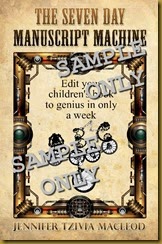
The rest of this post is an excerpt from my upcoming (now available!) book, The Seven Day Manuscript Machine: Edit your children’s book to genius in only a week. 

The_SevenDay_Manuscript_Machine Cover sample

(It’ll be available in paperback and Kindle very soon, so sign up for my mailing list to be notified of a terrific freebie deal I’m planning in return for some early reviews.)

Don’t worry; I’m not about to bawl you out for picking words that are too long or inappropriate for the age group you’re writing for.

I personally think a few big words are fun at any age. But how many is too many? And how do you know if you’ve gone too far the other way, talking down to older kids? (And there’s no better way to turn them off.)

Choosing the vocabulary for your children’s book can make a difference when it comes to finding young fans. You don’t want to choose “baby words” that are so simple your target audience feels like you’re talking down to them. No reader, of any age, likes to feel condescended to.

On the other hand, if your target audience is lost and confused when they run into too many unfamiliar words, your story will crash and burn. How do you challenge your reader just the right amount?

Know your target audience.

If you’re writing early chapter books to encourage a reluctant reader, keep your vocabulary simple, your action fast-paced, and your sentences short.

Tuesday, July 15, 2014

Basics, Part 3: Are you choosing words that zoom, screech, soar, sing?

image

You’re a writer, right?

And writing is all about words? 

(Come on, let me hear you nodding.)

So picking the words to go into your kids’ book should be simple… but it’s not.

In the first post in this series, Basics, Part 1: What is a children’s book? I laid out the most simple definition of a children’s book: 

  1. Pages between covers
  2. Aimed at young readers
  3. Usually illustrated
  4. All about story

In Basics, Part 2: Does your book measure up?, we looked at the first part of that definition:  pages between covers.  How many pages, exactly?  How many words?  Well, that depends on who you’re writing for.

And so does the language you choose to fill your book.

You want to choose words that zoom; words that soar; words that transport your readers and sing to them – or screech at them.

In Part 2, I actually gave you a chart, and I’m going to do the same thing here. 

Let me be honest:  a lot of people HATED the chart in my last Basics post.  These folks are artists, and I respect that.  And they refuse to be hemmed in by conventions.  Fair enough.

Life as an artist

But if you were an artist artist, I mean the kind that paints pictures, and somebody hired you to paint a family portrait to hang on the wall above their fireplace… would you measure the wall above their fireplace first?

I suspect you would.

And then you’d choose a canvas to fit the space, right?

(Just keep nodding.)

Here’s what you wouldn’t do:  go home, picking up any old size of bedsheet along the way; and proceed to paint the picture on a canvas that was huge… or too tiny to be seen.  If you do, I would hope you’d have the good grace not to get made at your client if he refused to pay for your work.

As most painters through the ages have discovered, working within size (and other) constraints probably won’t kill your artistic spirit.

So please don’t hate me for suggesting them.

Big, beautiful words