Sunday, December 7, 2014

15 gifts writers will scream for: the essential 2015 Write Kids’ Books gift guide.

image

You’re here because you’re a writer or know a writer, or both.  Either you’re looking for the perfect gift that will draw gasps of delight or screams of satisfaction (is that even a thing?), or you’re hoping to pamper yourself in the middle of this season of selflessness.

Either way, here are 15 great ways to give yourself permission to go for it.

1) Paperback room fragrance / cologne by Demeter

image If you haven’t tried Demeter perfumes, colognes and fragrances, you should.  They’re mindblowingly “real” scents in varieties you’ve never imagined:  Tomato, say, or Dirt, or Thunderstorm.  They all smell great.  Years and years ago, I got a bottle of their gin and tonic scent, and I loved it almost to death.  I still have the bottle, which I refuse to use up.  I sniff it from time to time when I need a pick-me-up.  But what could be a better pick-me-up for a writer in need of inspiration?  Available as a home atmosphere spray – to get you in the writing mood! – or as a cologne.  (The bottles look similar; make sure you choose the one you want.)

2)  Flying wish paper

image Write your heart out, then set it on fire.  Send your dreams upwards.  Hopefully you’ll wish for inspiration, and be rewarded with tons of great ideas and incredible words (that you won’t want to burn).

3) SimplyRain –

imageBetter than background music when you’re trying to write. 

Wednesday, December 3, 2014

The joy of unboxing: start with creating kissable covers.

image

Want your books to come out of the box looking gorgeous?

You can have that, and I promise you, it’s a great, great feeling.  I love books.  That’s why I do this… it’s all about the books.  Well, that and the kids.  (Which do I love more?  Don’t push me on this question…)

The secret to gorgeous books is… kissable covers.  Covers that you adore.

And when these books came in the mail today, the first hard copies of my chapter book, No Santa!  , that’s exactly what I wanted to do.  Kiss them, hug them, sleep with them tonight and forever.

I was actually worried that they wouldn’t be this good.  Why was I so anxious?  Because…

  • a) this is my first chapter book, and
  • b) I was worried about the covers, which I created completely on my own, from scratch. 

I was especially worried about the spine.  Createspace told me that because my book was so short (exactly 100 numbered pages of story), there was no room for words on the spine.  Maybe you’ve come up against this problem, too?

I’ve held enough kids’ books in my hands to know that this was total BS.  Even very tiny, thin paperback books have words on the spine.

But Createspace insisted that I couldn’t do what I wanted to do. 

Tuesday, December 2, 2014

Coping with the KDP Freebie Juggling Act: a simple 2-step system

image

Are you giving it away for free?

If your books are exclusive through Amazon’s Kindle Select program through KDP (Kindle Direct Publishing), they make it oh-so-easy to give away books for free.  They make it sound like a privilege, even.  Like it’s going to do tons for your books’ sales and your author ranking.

Will it really?

One school of thought, let’s call them School A, says – “No, no, no!  Never give it away for free!  Offering freebies trains your “loyal” readers to pay nothing for your books.  That’s terrible.  Don’t do it!”

The other school of thought, School B, says (equally loudly) – “Yes, yes, yes!  Giving books away for free will help new readers find your books.  They will become loyal readers!  Free books ‘hook’ them in, like a sample at the supermarket.  If they like it, they’re sure to come back and buy more (for actual money).”

As a fairly new writer trying to get established, I’m somewhere in between.  I do think freebies help get attention I wouldn’t get otherwise.  So I’m still doing them.

I don’t like keeping secrets.  I’m going to share what I’m doing here, but I’ll be honest:  I don’t really know yet if it’s working.  I hope this will be the start of a conversation, and I’d love to hear your thoughts and experiences in the comments.

If you have more than a couple of books enrolled in KDP select, you need a way to keep track of which ones are free at any given time.  That’s where this simple 2-step system comes in.  Follow these steps, and you’ll never get mixed up again.  You’ll also be able to reward your loyal followers with a chance at getting hold of these.

Here’s how I set up my KDP freebies:

Friday, November 28, 2014

GUEST POST: Moving Small Stones: Closing the Diversity Gap in Children’s Books

image

Welcome to my stop on The Secret Life of Jenny Liu book tour!  (Want to check out all the stops?  Here’s a list.)

Today, you’ll discover a tasty new middle-grade chapter book, and hear from its writer about why diverse books matter. 

What am I saying?  You’ve probably heard the buzz about diverse books already. 

But are you convinced yet?

Jean Ramsden is.  These days, she’s connecting with her readers one-on-one.  And she’s hearing from them how much it means to kids to see characters “just like me” in the books they read, on the covers, on the pages of magazines and on TV.

Jean’s book, The Secret Life of Jenny Liu (Jam & Jabber Books, 2014) is about an 11-year-old Chinese-American girl who defiantly refuses to be a stereotype.  When the world tries to shove her into a box, she bursts free and discovers she has the strength to be unique. 

The book confronts all the stereotypes head-on – Jenny is Asian, but she’s no good at math and spelling, and she’s not the piano whiz her teacher and slightly-tiger mom hopes she’ll be.  I loved watching Jenny solve her own problems, finding balance in her own life and helping others along the way.

So why do diverse books matter?

Let’s let Jean speak for herself…

Moving Small Stones: Closing the Diversity Gap in Children’s Books

The Secret Life of Jenny Liu, by Jean Ramsden The fury of activity following my book reading had subsided—questions had been answered, books had been signed, kids and their parents and teachers had moved on to the next event—when a girl holding her copy of my middle-grade contemporary book, “The Secret Life of Jenny Liu,” approached.  

Wednesday, November 26, 2014

How NOT to get reviews. Three top turn-offs reviewers HATE.

image

You’re a writer, right?  So you’re only one letter away from being a WAITER, which isn’t a bad way to think of yourself when it comes to getting reviews.

Like a waiter, you have to serve up your book to reviewers in the most appealing possible way.  And if you forget the basics of customer service, it’ll bounce back to bite you in the form of a lousy tip – er, review.

Here are three ways you may be turning off reviewers – and what to do about them to make sure those reviews keep rolling in.

Monday, November 24, 2014

Caution, Rant: spammy spammers spamming stupid “Children’s Books” in their KDP listing title.

image

Every once in a while, I’ve just got to rant.  Maybe you know the feeling?

Today’s rant is about that growing breed of Kindle kids’ ebooks that have almost more title than actual book.  I’m sure you know the ones:  the cover of the book has maybe a five-word title, but the title of the book as shown on its Amazon listing is a mile long, like this:

Children books : MARGARET AND THE DONUT: (Explore the Galaxy kids book exclusive collection) (Super-Duper eBook)Sleep & Playtime Books(Short Story) (Bedtime ... Books for Babby & Toddler Readers #15) [Kindle Edition]

You think I’m joking?

Fever Pitch: 1-step first aid for sick stories

image

Is your story sick?  Something not quite right?

Your spelling and punctuation may be perfect, but if something just seems off… if it’s under the weather, but you’re not sure how to fix it…

… just pitch it.

No, I don’t mean throw it away.  I mean create a sales pitch and start selling your book.  Not (yet) on Amazon, or Kobo, or Smashwords, or anywhere else.  No, to make it great, you have to sell the story to your most important customer – yourself.

You’ll do that with a “pitch.”  Known by a few different names, it’s basically a 1-2 sentence “elevator speech” for the book.  This pitch has to be great.  It must hook the reader – and before it’s ready for readers, it has to hook YOU.

Sunday, November 23, 2014

CLOSING SOON! 3 free (LEGITIMATE) contests for indie kids’ writers.

image

In the age of spammy contests, with scammy reviews and prizes being awarded left, right and centre (and preying on our eagerness to help our books stand out), it’s nice to know that there are still a few legitimate places you can send your books. 

These are folks you can trust to evaluate your book honestly against the best of what’s out there in children’s literature today.  It’s a tough game, but at least you know it’s not rigged.

Is your book a winner?

Consider submitting it to one of these three free contests.  (I already have, in 2 out of 3 cases.)

But hurry!  They’re all closing soon…

  1. If your planned publication date is January 2015 or onwards, check out this challenge to indie kids’ writers from Horn Book editor Roger Sutton.   Submit by December 15th.  For this one, you have to send a physical copy, and there are some other requirements as well.  I expect that his standards will be very high, but the prize – if someone wins it – is soooo worth it.
  2. Still a week left to submit to the Gittle List 2014!  Submit your picture books (for ages 10 and under) by November 30th.  Your book does not have to have been published in 2014 to enter.  You can submit electronically or send her a physical book (if it gets there in time).
  3. image Another one to submit to by December 15th is the SCBWI Spark Award.  This one is technically free to enter, but you’ll have to be a SCBWI member first (I am for the first time this year, yay!).  You’ll need to submit a physical copy of your book for this one, too.  Read the full guidelines here.

To get a sense of what each contest is looking for, it’s helpful to look at past winners.  It’s not foolproof, but it can help give you a sense of what each is looking for.  Here are last year’s SPARK award winners, and the Gittle List 2013 winners.

When thinking about any other contests or awards (or review “services”), always check out Writer Beware first before entering.  Most, unfortunately, are scams, and will charge you both to enter and to buy their rolls of prize stickers after (surprise, surprise) they announce that you’ve won.

Good luck… and may the best books win.  Wait, scratch that.  When we write great kids’ books, it’s the KIDS who ultimately win.  So submit your heart out, if you dare – and win it for the kids!

Wednesday, November 19, 2014

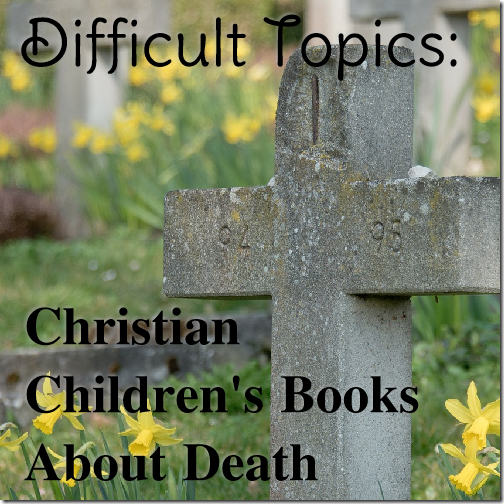
DEALING WITH DIFFICULT TOPICS: 3 Good Christian Children's Books About Death

image

(Guest post by Sheila C. Skillman.)

There are several appealing children's books on the market either helping parents to explain death to young children, or targeted directly at children for their reading pleasure, which incorporate an explanation of death. But surprisingly few of these are specifically Christian books. However, I am able to recommend three such books which are very engaging.

B00D82131W1) Water Bugs and Dragonflies by Doris Stickney was published by The Pilgrim Press in 1982. This is a very small, slim book, containing a story which starts below the surface of a quiet pond among a little colony of water bugs. The story finishes with the transformation of a water bug into a dragonfly and illustrates beautifully the fact that the dragonfly cannot return below the surface of the water to tell the water bugs what has happened to it, and what life is like in its new body. A prayer follows, which the child reader may use as a guide when praying for the person whose loss he or she is mourning. The book then gives notes for parents advising them on what they can say to a child about death, and backing this up with quotations from Matthew and Mark showing the way Jesus approached little children. The book ends with a prayer for parents. I think this is an ideal resource for parents who might be unsure and insecure about how to handle the subject.

image

image 2) Will I Live Forever? by Carolyn Nystrom illustrated by Jo-Anne Shilliam was published by Lion Hudson in 2006. Told in the first person through the viewpoint of the young child, it directly addresses the reader with a question about sad, scary thoughts, and then relates those questions to the child's world. The story encapsulates the Christian understanding of why we die, starting with the story of the Creation, and of Adam and Eve in the Garden of Eden. It goes on to incorporate quotations from the Gospels. It is also very honest and straightforward about the physical processes of death - the corruption of the body, the reason why it must be cremated or buried, etc. It goes on to reflect upon heaven - once again answering the kind of direct, logical questions a young child will demand to be answered. This is an excellent book, one you will wish you'd had access to when you were a young child.
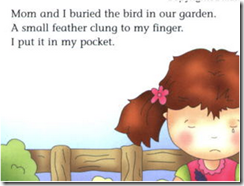
Image from Will I Live Forever? by Carolyn Nystrom, illustrated by Jo-Anne Shilliam

image 3) Grandma's Party by Meg Harper, illustrated by Paul Nicholls, was brought out by The Bible Reading Fellowship in 2003. This is a delightful book centred around the funeral of a grandmother, and it offers practical ways to help children be part of the grieving process when a loved one dies. It includes a story and also creative craft ideas for how a child may become involved in preparing for a tea following the funeral; recipes; instructions on calligraphy to make place cards; and how to make picture frames, books of memories, and paper water-lilies. The book has a solid Christian base, explaining the resurrection from the dead, and finishing with prayers which may be read by a child at the funeral. This is a lovely, practical book, helping parents to understand how to involve and include children at every stage, so they may live out the truth that death is a part of life, not something alien and taboo and frightening, to be hidden behind a wall of silence and mystifying rituals.

image

image S.C.Skillman is the author of mystery romance novel "Mystical Circles" in which Juliet, concerned that her younger sister has fallen for the charismatic Craig, leader of a dubious New Age spiritual group, sets off for the Cotswolds to see the situation for herself. She arrives at Craig's community hoping to rescue Zoe. But intrigues, liaisons and relationships flare and flourish or fizzle out quickly within this close circle and, despite her reservations, Juliet is drawn into the Wheel of Love... with completely unforeseen consequences.
Mystical Circles is now available as an e-book on Amazon Kindle. You can find out more by visiting the author's blog at http://www.scskillman.com.
Article Source: http://EzineArticles.com/7018789

Monday, November 17, 2014

$5 to illustrate your book? Yes, please! (a fiverr artist speaks up)

image

My post How to get your children’s book illustrated for $5 on fiverr inspired a veritable poo poo storm of hostility, not just from non-fiverr illustrators, but from many others in the children’s book world. 

That made me sad enough that I wrote a follow up post , Why hiring a fiverr artist for your kids’ book WON’T destroy the universe which inspired a poo poo storm of its own.

So when fiverr artist Eka Saputra, from Indonesia, stopped by to share his views in the Comments section, I felt he deserved a post of his own to hopefully bring some sanity to this stinky storm.

Here’s what Eka has to say:

After reading this post and the previous one, as one of freelance illustrator in fiverr, I can't stand not to post a comment to show you my perspective.

Saturday, November 15, 2014

GUEST POST: Writing Children's Books: Using Proper Fonts

image

(Guest post by Irene Watson.)

Writing a children's book is hard, but so is illustrating and designing it. Yet everyone seems to think he or she can create a children's book. Plenty has been written about why children's book authors need feedback from children on the story before they publish a children's book. But just as important is getting feedback on illustrations and from the adults who might actually be the ones who read the book to children. No matter how good the story might be, more than with any other type of book, how a children's book looks is going to determine whether kids or adults want to read or buy it.

In other words, hire a professional illustrator and a professional layout and design person. In this age of computers and all kinds of graphic design programs, everyone thinks she can design her own children's book. The result is usually a disaster made by someone who doesn't understand that less is more. Many things need to be avoided when designing a children's book. Based on years of experience reviewing children's books and seeing what my children and grandchildren have and haven't liked, here are a few tips on what not to do:

Unprofessional Artwork

With a children's book, a picture is worth a thousand words, and trust me, little kids know the difference between good and bad art. You may not be able to tell what they are depicting in their own drawings, but they know when something "sucks."

Wednesday, November 12, 2014

How to be a Super Blogger in 2015 (or why you should give up now).

image

You may have noticed that I don’t just write children’s books. 

And I don’t just write adult books.

A lot of what I write is here before you on this site.  For better or worse, I’m a blogger.  I’ve been at it for almost a decade.

When I started, I was a mom with a newborn, and that newborn turns 10 this winter.  She’s not the same, and neither am I.  And neither is the state of the blog world.

Here’s my “state of the blogger” analysis of what’s going on in the blog world.

Good news, bad news

The bad news

Blogging is very 2005.  When people hear that you have a blog, they run and hide.  It’s not a cool thing at all.  Hardly anybody under 30 has a blog, it seems.  They don’t have time to read anything more than about 175 characters.  Go over 500 words and you’re downright long-winded.  (Hope I didn’t lose anybody mid-paragraph.)

The good news

Some blogs today are very, very good.  Excellent, even.

The bad news

The good blogs are usually selling something.