Showing posts with label religion. Show all posts

Tuesday, November 21, 2017

Finishing your book–the “nibbled to death” way

image

I'm working on a book.  I've been at it for a while, in fact.  Years.  And guess what?  I'm on page 11 already!

So... okay. 

Go on. 

Say it to my face - exactly what you're thinking.

Which is probably something like, "That's not much for years of work."

"Page 11?  That's not very good."

"Eleven pages?  I could do better than that."

"A turtle could do better than that."

Yes, it's true.  Page 11 is not very far into a book.  It's going to take a loooong time to finish.  A year, to be exact.

But I will finish, I do know that.  And in a year, I will have a book under my belt.

When I started looking for images to use as the heading for this post, I was thinking seriously about a turtle, because a turtle is a great symbol for slow and steady winning the race.  We all recognize this guy from the Aesop’s Fable story, right? 

image

Yeah, yeah, turtles.

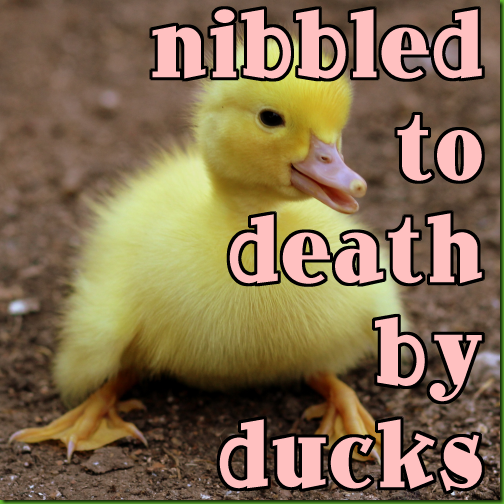
But really, a better image is ducks.  This guy:

image

There’s an expression I hadn’t heard before a few years ago, and it sums up my strategy for getting this book DONE, and that is:  "Nibbled to death by ducks." 

What does it mean?  Well, look at that duck.  He's pretty cute, right?  That beak totally doesn’t mean business.  He looks like a lightweight for sure.  If you let him nibble at you, he wouldn’t do much damage.  Unless he kept nibbling.  Just kept nibbling and nibbling and nibbling…

Well, okay, that’s getting a little gross.  My point being, one nibble by one duck doesn’t do much damage, but

Tuesday, January 17, 2017

Want to teach values in a kids' book? Put them in the background!

image

Got a message you’re dying to share?

I’ve been there.

But those of us who do have a real problem.

I’m sure you’ve heard before – and I’ve certainly said it before – that kids’ books shouldn’t be used to preach at kids.  If you put that message first and fill your book chock-full with good healthy values, you’ll end up with a terrible book that kids simply won’t enjoy.

Think of zucchini.  Nobody in my family likes zucchini very much.  If you adore zucchini, think about another vegetable.  Eggplant, maybe.

Now, you know you should eat zucchini.  It’s super-good for you, right?

But if I were to cook up a big batch of zucchini for my family, they’d all sit and stare at it – myself included – and not know what to do with it.  That zucchini would sit uneaten on the plate.

Now here’s the cool part:  we actually eat a LOT of zucchini.  We eat it sliced into chicken soup every Friday night; we eat it grated into latkes and any number of savoury dishes; we eat it pureed into potato soup.  I’ve even baked zucchini bread, though yes, I understand, it’s not entirely super-good for you if it’s surrounded by flour and sugar!

The trick to zucchini, or whatever veg you don’t like very much, is to put it in the background, and the same is true for morals, values, or any other type of lesson you’d like to embed in your book.

In my new book, Yossi and the Monkeys (2017, Kar Ben Publishing), there are a ton of what the publisher probably calls Jewish values, but which I consider pretty universal.  Here’s the first page:

image

What values are here – in the background?  There are things Yossi really wants, but they are not selfish wishes; they are things he wants for his family. 

(So I don’t have to come out and say something annoying like, “Don’t be selfish!”  Kids know that already anyway, so they’ll just tune you out if you try.)

The holiday itself is another value right here on this front page:  I love writing stories with Jewish holidays in them but which aren’t about the holiday.  There are too many “what is Chanukah?” books out there for me to want to contribute to the genre, plus those kinds of books have always bored my children, who have known since infancy what all the holidays are about.

(Notice I haven’t said: “Shavuot is a wonderful festival in which Jews…”  This book isn’t about Jews in general, so forget about them.  This is Yossi’s story.  Just in case the reader isn’t familiar with the festival, the publisher has included a short paragraph about it on the copyright page.)

Here are two more pages from later in the story:

Thursday, April 23, 2015

How to write an author bio that will sell children’s books

image

Have you ever READ an author bio?

Probably you have.  That’s because you’re a writer, so you’re interested in other writers.  At least, I know I am.

Here’s the thing:  you’re not a kid.  Let’s be honest:  it’s not kids who will be reading your author bio.

Most kids couldn’t care less about who wrote the book, unless they’ve finished one and are looking for more of the same.  So it’s probably parents, grandparents, teachers and librarians who will be reading the author bio. 

There are two kinds of people who are reading your author bio:

  1. People who aren’t sure whether they should buy your book
  2. People who have read your book and want to know more about you

In both cases, a little honesty can go a long way.  In both cases, you want to make a connection that is friendly and personal (not commercial!).  You want them to trust you and – maybe, just maybe – to like you.

Let’s look at ways we can make the bio as appealing as possible without being crass.  What you don’t want is for your bio to sound like marketing copy.

Here’s the trick:  you want your bio to be relatable, which means not too weird.  But you also don’t want it to be so tedious that you are ultimately forgettable.

What should you call yourself?

For some writers, the hardest part of creating an author bio is describing themselves in the third person.  As tempting as it may be to say “I’m a mom of 4, a SCUBA diver and a cat lover,” resist. 

Suck it up, and keep yourself in the third person.  It just looks and sounds better.

The best advice I can give you is to read 5-10 bios of well-known children’s authors before you sit down to write your own.  I think it’ll inspire you, offering hints as to voice and how to streamline your message effectively.

Go long or stay short?

Thursday, March 19, 2015

Are you racist – and you don’t even know it? 3 easy ways to fix it.

image

You know you’re not racist.  But do your readers know it?

Check your writing for signs of these 3 mistakes.  They’re probably there unintentionally, but rest assured that readers will find them – and take it personally, even if you didn’t mean any harm.

Be prepared to root out these problems wherever you find them.  Let’s try to create books that accurately reflect children’s reality, regardless of their skin colour or socioeconomic status.

Only one, or Tokenism

I’m sure you’ve seen this one before:  all the characters in a story are white… except one.  You can see the one black, or Asian, or East Indian, character hanging out in all the illustrations.  Maybe it’s one character in a wheelchair, or a girl in a hijab.  Or one character with some other type of difference, whatever it may be.

Yes, diversity is important.  But that doesn’t mean throwing in a single character of a particular “type,” simply to serve the goal of diversity.

QUICK FIX:

Tuesday, December 9, 2014

12 nights of Chanukah fun: a mega Jewish holiday picture book roundup

image

Before you read any further, you should know:  these aren’t exactly reviews.  They’re BETTER.

(That’s also why I want you to read this even if you don’t celebrate Chanukah.)

What could be better than reviews?

As writers, we’re at work even when we read for fun (even when we read to our kids), and that’s a serious job.  We have to examine each book not simply for whether or not we enjoyed it (like ordinary readers do), but analyzing it to figure out IF it works and HOW it works.

That’s the only way we can make our own writing better.

Working while we read (for pleasure)

When I took a children’s picture-book writing course earlier this year, I had to research “comps” – comparable books on a similar topic.  Since I was working on one of my Chanukah books, I decided to research what else was out there in the world of Chanukah books.  I chose these books almost at random, but I think it’s a good assortment of what’s out there.

Have fun reading through them, and hopefully discovering a few new favourites. 

  • How Do Dinosaurs Say Happy Chanukah? by Jane Yolen, illustrated by Mark Teague
  • Mrs. Greenberg's Messy Hanukkah, by Linda Glasser, illustrated by Nancy Cote
  • Esther’s Hanukkah Disaster, by Jane Sutton, illustrated by Andy Rowland
  • Chanukah Lights, by Michael J. Rosen, illustrated by Robert Sabuda
  • Latkes, Latkes, Good to Eat: A Chanukah Story, written and illustrated by Naomi Howland
  • The Story of Hanukkah, by David A. Adler, illustrated by Jill Weber
  • Sammy Spider's First Hanukkah, by Sylvia A. Rouss, illustrated by Katherine Janus Kahn
  • Biscuit's Hanukkah, by Alyssa Satin Capucilli, illustrated by Pat Schories
  • Elmo’s Little Dreidel, by Naomi Kleinberg, illustrated by Christopher Moroney
  • Light The Lights! A Story About Celebrating Hanukkah And Christmas, by Margaret Moorman
  • Engineer Ari and the Hanukkah Mishap, by Deborah Bodin Cohen, illustrated by Shahar Kober
  • Battle for Torah: The Message of Hanukkah, by Kay Kindall, illustrated by Neil Kindall

While you’re reading through these short blurbs, take a look at some of the different ways we – as writers –should be analyzing “comps.”

What to look for

Wednesday, November 19, 2014

DEALING WITH DIFFICULT TOPICS: 3 Good Christian Children's Books About Death

image

(Guest post by Sheila C. Skillman.)

There are several appealing children's books on the market either helping parents to explain death to young children, or targeted directly at children for their reading pleasure, which incorporate an explanation of death. But surprisingly few of these are specifically Christian books. However, I am able to recommend three such books which are very engaging.

B00D82131W1) Water Bugs and Dragonflies by Doris Stickney was published by The Pilgrim Press in 1982. This is a very small, slim book, containing a story which starts below the surface of a quiet pond among a little colony of water bugs. The story finishes with the transformation of a water bug into a dragonfly and illustrates beautifully the fact that the dragonfly cannot return below the surface of the water to tell the water bugs what has happened to it, and what life is like in its new body. A prayer follows, which the child reader may use as a guide when praying for the person whose loss he or she is mourning. The book then gives notes for parents advising them on what they can say to a child about death, and backing this up with quotations from Matthew and Mark showing the way Jesus approached little children. The book ends with a prayer for parents. I think this is an ideal resource for parents who might be unsure and insecure about how to handle the subject.

image

image 2) Will I Live Forever? by Carolyn Nystrom illustrated by Jo-Anne Shilliam was published by Lion Hudson in 2006. Told in the first person through the viewpoint of the young child, it directly addresses the reader with a question about sad, scary thoughts, and then relates those questions to the child's world. The story encapsulates the Christian understanding of why we die, starting with the story of the Creation, and of Adam and Eve in the Garden of Eden. It goes on to incorporate quotations from the Gospels. It is also very honest and straightforward about the physical processes of death - the corruption of the body, the reason why it must be cremated or buried, etc. It goes on to reflect upon heaven - once again answering the kind of direct, logical questions a young child will demand to be answered. This is an excellent book, one you will wish you'd had access to when you were a young child.

Image from Will I Live Forever? by Carolyn Nystrom, illustrated by Jo-Anne Shilliam

image 3) Grandma's Party by Meg Harper, illustrated by Paul Nicholls, was brought out by The Bible Reading Fellowship in 2003. This is a delightful book centred around the funeral of a grandmother, and it offers practical ways to help children be part of the grieving process when a loved one dies. It includes a story and also creative craft ideas for how a child may become involved in preparing for a tea following the funeral; recipes; instructions on calligraphy to make place cards; and how to make picture frames, books of memories, and paper water-lilies. The book has a solid Christian base, explaining the resurrection from the dead, and finishing with prayers which may be read by a child at the funeral. This is a lovely, practical book, helping parents to understand how to involve and include children at every stage, so they may live out the truth that death is a part of life, not something alien and taboo and frightening, to be hidden behind a wall of silence and mystifying rituals.

image

image S.C.Skillman is the author of mystery romance novel "Mystical Circles" in which Juliet, concerned that her younger sister has fallen for the charismatic Craig, leader of a dubious New Age spiritual group, sets off for the Cotswolds to see the situation for herself. She arrives at Craig's community hoping to rescue Zoe. But intrigues, liaisons and relationships flare and flourish or fizzle out quickly within this close circle and, despite her reservations, Juliet is drawn into the Wheel of Love... with completely unforeseen consequences.
Mystical Circles is now available as an e-book on Amazon Kindle. You can find out more by visiting the author's blog at http://www.scskillman.com.
Article Source: http://EzineArticles.com/7018789

Wednesday, September 3, 2014

How I ended up writing a Bible story (and why you might, too).

Excerpt from Writing the Bible for Children:  How to write blazing Biblical stories and picture books for kids.
I never write a story I don’t love.

But sometimes, it’s possible to write a story you don’t like very much, at least at first.  Stories can grow on you surprisingly quickly.

The scrawny chicken baby


Years ago, I wrote a personal essay about how I didn’t bond with my daughter instantly.  She was a preemie, scrawny and demanding, her wail high-pitched and insistent.  Her birth was unexpected, my marriage was in trouble; it just wasn’t the best time in my life to have a baby, and then she was whisked away to the neonatal ICU moments after birth. 

Trust me, it wasn’t the best setting for mother-baby bonding.

Yet I fell in love with my daughter anyway, albeig on her second day, because the first was just so crazily difficult.  That story, one of my most successful, was later anthologized in the book Chicken Soup for the Mother-Daughter Soul.

The fact that editors loved it, that it sold almost instantly tells me two things:  one, I’m a great writer (yay for modesty!) and two, a lot of people have gone through that experience of not bonding instantly – of falling in love with their baby a little late but just as deeply.

(That daughter, who will turn 19 soon, has never forgiven me for referring to her as a “scrawny chicken baby” in the story.  She doesn’t care that there’s a happy ending!)

I mention this because you may experience the same thing with a Biblical story.  Or perhaps with all Biblical stories.

Most of them are hard to love, at first.

Most of them are pretty scrawny, for one thing.  From a modern perspective, they’re short on details:  there’s almost no attention to basics like character development, establishing the setting, or on making sure the thing flows from one narrative to another. 

If it wasn’t God’s book, you could easily imagine it getting one or two stars on Goodreads or Amazon.

Wednesday, July 9, 2014

Christian without the Cringe: 5 ways to craft stories with spirit

image

Are you Christian? 

If so, you’re right up there with 76% of Americans who believe in some form of Christianity

But I’m not.

Our family is Jewish, and I’ve written about writing Jewish children’s books a few times before.  I thought it would be both fun and fair to my non-Jewish readers to offer a bit of breadth and invite a friend to talk about her approach to writing Christian children’s literature.

Polls show that more than 90% of Americans believe in God. 

They may not all be deeply devout, but many are, and that means hundreds of thousands of parents looking for books that reflect their own family’s values.

This is a major market.

I’m not deeply sad that I don’t get a slice of this pie, but I’m happy to be able to share her tips to help you reach these families, if that’s part of your writing goal.  With these 5 tips, I hoped to help you turn out books that are Christian without the “cringe” factor. 

You know what I’m talking about, right?

But then I read her post, and realized it wasn’t just for Christian writers. The rest of us need to read this, too.

Tuesday, April 22, 2014

‘Tis the season – write holiday books that don’t spell HUMBUG (Part 2 of 2)

happy holidays!What the heck is a holiday-books post doing here in April? And not just any post – this is Part 2 of a 2-part series! (Click here to read Part 1 first.)

Well, for one thing, not all of us celebrate our main holiday in December. Plus, if you’re thinking of writing or wrapping a book aimed at the December holiday season, April is actually a great time to be planning it.

In Part 1, we looked at four big Do’s and Don’ts to help get you on the right track.  Now, we’re going to look at one final question you need to ask yourself before you sit down to write – who are you writing for???

buy Rashad's Ramadan and Eid al-Fitr, by Lisa Bullard

Finding your audience

Is your book aimed at kids and families who celebrate the holiday, or those who don’t?

As a religious Jew, I can’t tell you how many Chanukah books I decided were ultimately inappropriate for my family because they explain too much.

Saturday, April 12, 2014

‘Tis the season – write holiday books that don’t spell HUMBUG (Part 1 of 2)

happy holidays! What the heck is a holiday-books post doing here in April? And not just any post – this is Part 1 of a 2-part series. (Click here to read Part 2.)

Well, for one thing, not all of us celebrate our main holiday in December. Plus, if you’re thinking of writing or wrapping up a book aimed at the December holiday season, April is actually a great time to be planning it.

Certainly, when you’re in the thick of holiday excitement is NOT the time to think you can take time out to write your best work.

Since I myself have a major holiday coming up in 2 days, I have been procrastinating – big time. And you, my friends, are the big, big winners.

Here, in Part 1 of this 2-part series on “Writing Kids’ Holiday Books,” are some quick Do’s and Don’ts to help you get those holiday kids’-book juices flowing.

buy Sammy Spider's First Passover

DO get fired up with holiday excitement

Figure out what you love the most about the holiday you’re writing about… and then capture that excitement on paper. (Well, monitor – but you know what I mean.)

Frankly, I’ve seen a lot of bad kids’ holiday books out there, many of them self-published (hint: