 How do you feel when classic books, written and intended for ALL children, are remarketed today as “boys’” or “girls’” books – if not explicitly, then through subtle cues like colours and patterns on the cover?
I had the rare experience of going into an actual bookstore in a mall the other day, and because Naomi Rivka was with me, we ended up in the kids’ section. (Okay, that’s a LIE – I end up in the kids’ section every time, whether I have kids with me or not!)
There, I spotted this brand-new, contemporary, SCREAMY PINK cover on
Matilda, a classic, favourite Roald Dahl book:
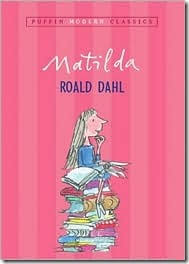
A Google image search reveals several evolutions of this book’s cover over the years. Here’s what our worn-out old copy looked like, back when it had an intact cover:

Here are a couple of other nice early gender-neutral covers:


But this new stripey version is far from the first pinkish iteration, as you can see here.


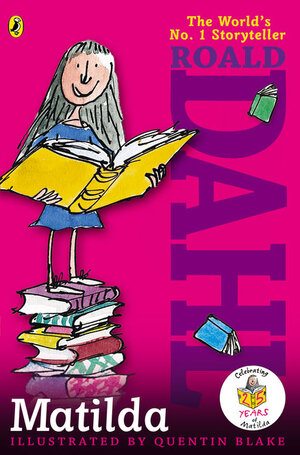
Same main character, new, girly-pink background.
I thought of this today because of a picture that’s been
floating around on the Internet for a while now – an ad showing a little girl in the 1970s or early 80s, building with Lego.

The girl is wearing a neutral-coloured T-shirt (actually, there’s a bit of blue trim). The Legos themselves are basic Lego colours: blue, red, yellow, green, black. Why?
Because Legos are a gender-neutral toy.
You can be a boy or a girl and still play with Lego – or at least, you could in 1981.
In 2014, not so much:


Today, nobody seems quite so sure, as marketers rush to convince girls that all the best stuff comes wrapped up in a nauseatingly candy-coloured blend of pink and purple. For more on the craziness and hype behind marketing to girls, particularly how it started, and the kind of money involved, there’s a great grown-up book called
Cinderella Ate My Daughter, by Peggy Orenstein.
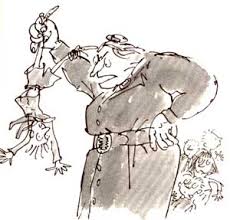
Here’s what I think Roald Dahl himself would have had to say about this type of silliness and any effort to sell
Matilda as a book for or about GIRLS, instead of just as a book for and about PEOPLE:

I had a fun discussion with my kids around the table about this yesterday – about why
Matilda is pink, for instance, but
The BFG, which also revolves around a female main character (Sophie), is not. (One kid thought this was because the other main character is a large and male giant, but I pointed out that the Queen of England also appears in the book, which ought to trump any old giant.)

In any event, we all agreed that the cover for
Charlie and the Chocolate Factory, really ought to be brown (even though it isn’t).
And by the way –
Roald Dahl? Unbelievable writing role model.
Just in case you think book-writing comes easily to prolific and talented writers like Dahl, think again. Here’s what he wrote in a letter to his own daughter, Lucy, about the process of creating his books: “I must have rewritten
Charlie [and the Chocolate Factory] five or six times all through and no one knows it…”

Here’s how the process went with Matilda:
…And now at last I have finished it, and I know jolly well that I am going to have to spend the next three months rewriting the second half. The first half is great, about a small girl who can move things with her eyes and about a terrible headmistress who lifts small children up by their hair and hangs them out of upstairs windows by one ear. But I've got now to think of a really decent second half. The present one will all be scrapped. Three months work gone out the window, but that's the way it is.
Think about
that when you are weeping over cutting some precious paragraphs from a manuscript to comply with picky readers’ or editors’ (or – gasp! – kids’!) requests… three months work, out the window.
(I like this picture, by the way, because it proves that everybody used to smoke, not just evil stinky people!)
I bet I know what he’d do to anyone who tried to tell kids NOT to read it – which is essentially what a stripey pink cover announces to boys: “Hey, guys, this is NOT for you!”
So what kept him going through all the difficulty?
My lucky thing is I laugh at exactly the same jokes that children laugh at and that’s one reason I’m able to do it.
Laughter. Indeed. The laughter of children, not boys, or girls… just kids.


