Showing posts with label faves. Show all posts

Monday, March 2, 2015

Is your kids’ book blah or blechhhh? These 10 FREE font pairings add a professional touch.

image

Picture a mom, surfing Amazon one morning.  Maybe she’ll buy your picture book?  It’s perfect for her kids.  The cover sure looks promising, she thinks.  She clicks on it to Look Inside.  She skips through a couple of pages, and suddenly, she’s shaking her head. 

Something’s clued her in.  She’s figured out that your book is self-published and she suddenly has no desire to read any further.

What went wrong???

Readers don’t usually know exactly what’s turned them off about a self-published book.  But a lot of the time, badly-chosen fonts are the culprit.  Maybe your fonts are amateurish?  Maybe you’re using cruddy novelty fonts that make your book hard to read or dizzying on the page?

Today, there are so many great great FREE font choices out there.  Your book doesn’t have to be the one she clicks shut.  It could be the one she clicks Buy for instead and eagerly waits for it to show up in her mailbox so she can share it with her kids.

You may not be a professional graphic designer, but you should have some understanding of the basics of what makes a good font combination.  The fonts of your book should be:

  • clear
  • readable (for adults and kids)
  • normal, ie not attract TOO much attention

I’m sure you’ve seen children’s stories that look like this.  The text is muddled and hard to read:

image

So how can you rescue your book from falling into the same trap?

Ten free font combos to the rescue!

These 10 winning font combos are superheroes of the modern design world.  They’ll help you perk up any kids’ book and create just the right mood for your story.  These 20 fonts are all free, so there's no excuse to stick with Calibri, Times New Roman, Papyrus or (gasp!) Comic Sans anymore.

Saturday, February 15, 2014

L-O-V-E spells: a short paean to kids’ books.

image L is for lions, so scary or so meek,
O is for owls, whether or not they speak;
V is for violence we’d all like to avoid,
and E is for excellent, the books we’ve all enjoyed.

Whether in chapters, with pictures or not,
The books that we love all share a special spot;
So share the love that words can weave with children far and near,
And give your love a Valentine that's made of BOOKS this year!

(a little late for valentine’s day, but nonetheless!)

1607467658A great classic book for kids, or the young-at-heart:  Mercer Meyers’
Professor Wormbog in Search for the Zipperump-a-Zoo, a book that will always, always (for some mysterious reason) remind me of my little sister Sara, who celebrated her Valentine’s birthday yesterday.

What do you love about children’s books???  And what children’s books do you love to share with the kids who are most special to you?

Monday, January 6, 2014

Early children’s books.

Raise your hand prissily if you don’t get a tremendous tee hee reading through this with all the F’s that aren’t really F’s.  “To fee if the corn is almoft ripe.”  Tee hee.

(I come by it honestly:  my mother’s name is Susan, but my father, tickled by old-fashoned handwriting, used to call her, affectionately, “Foovan”, because of the S’s.)

Since early children’s book writers clearly hadn’t heard of Mistake #1:  Tossing in Values, those first books had purely moral intentions – sometimes pretty scary ones involving hellfire (heckfire, if the former offends you). 

image Later, it was discovered that they were also a great way to teach children to read.  But ideally, as with the American McGuffey Readers in the 1800s (a series I adore, by the way, and still use with my own kids), books would do double-duty, sharing a moral lesson AND teaching children to read!

When books were rare and precious.

image This was before the days of Print On Demand:  books were rare and precious, and most families – heck heck, most schools – only had a few. 

So you crammed as much as possible onto each page.  They had math texts back then that could fit into your hand and cover the entire mathematics curriculum from Grades 1 to 12.  Maybe not in as much detail as a slow math student like me would prefer, but there it was.
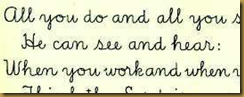
imageThese were all-purpose texts, too.  Even the McGuffey readers included “Slate Work” in the form of script-handwriting lessons interspersed with the with the stories and poems.  Of course, these, too, were designed for double duty, dishing out moral lessons about faith and hard work right along with the handwriting practice.

Kids today are daunted by script – I read somewhere about a girl who had to learn script so she could send letters back and forth with her grandmother.

What else is different today?

Forget about fonts.

imageToday’s kids’ books make liberal use of fonts – well, except for good old script handwriting, which seems to have been completely eliminated from our kids’ repertoire.

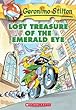
Indeed, books like the popular (accidentally typed “poopular,” maybe it means something?) Geronimo Stilton series (this page is from Lost Treasure of the Emerald Eye, one my kids adore), at times seem to rely more on font and novelty than on actual plot – let alone moral virtue.

(Not a fan of this series, but not for any reason I can put my finger on, and I’d never forbid the kids from reading them based on my own intuitions.)

0307010856Anyway, who can blame them when there is such marvellous precedent from the previous generation of kids’ books, the books of the 1970s and 1980s that were the first to break with morality, convention, with everything?

imageInstead of these tried-and-true formulas, this generation created fun, eclectic Free-to-be-type books that (sometimes literally, like in Grover’s 1971 classic, The Monster at the End of This Book, smashed all precedent to create the totally new artform in which Geronimo Stilton is free to play today to his heart’s content.

image 

(Okay, it’s late, I’m tired.  Hands up; bonus hug for anyone who followed that last sentence!!!)

Forget about trees.

Today, you get taken to task if you don’t make careful use of whitespace – or, what those early children’s book pioneers would call “intentionally waste space in your book.”
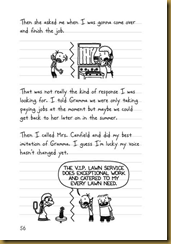
image 0810983915And rather than one picture per story (regardless of how many pages each story ran), you'd darn well better include a picture on each page if you expect hold kids’ attention.

Better yet, make like successful Diary of a Wimpy Kid author Jeff Kenney and many of today’s graphic novelists and forgo the words part altogether.  (Okay, comics and Diary of a Wimpy Kid HAVE words… but they are generally incorporated among other graphic elements, rather than carrying the story alone.)

Forget about stopping progress.

Not that I want to!  I love today’s kids’ books.  I’m not panicking about their future, by any means, and I’m always excited to see what the future will bring.

But sometimes, when I see the woeful choices my children make and chuckle over (this is code for the entire body of literature that relies primarily on fart jokes for its readers’ edification), I yearn for a simpler time.  Don’t we all?

0694003611I yearn for Goodnight Moon. (An Israeli woman once told me she found this canonical book creepy!  Really, it’s creepy to have an old lady in your room watching you fall asleep?  I always thought this was kind of sweet, but maybe she has a point.)

image

B00ES279V4I yearn for The Velveteen Rabbit.  (Does anyone still read this?  I thought about it once but realized it was too long to hold my attention span, let alone my kids’.  There – painful true confession.  Maybe I should try again now that they’re older.)

B000FCK65WI yearn for A Tree Grows in Brooklyn – a wonderfully shocking YA book easily as scandalous as anything today’s teens encounter.

Or is it perhaps not a simpler time I yearn for but a “fimpler” one, a world full of fimple ftories that won’t confound or confufe uf.  “Come, it is Auguft.  Buy a fharp fickle; you muft cut down the corn and eat fome.”

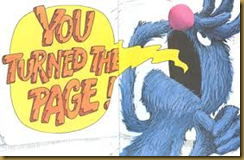
Ah, but you can’t stop progress.  Or, as Grover might put it,
image

What modern changes do you love in the world of kids’ books?  What can’t you stand?  If you could go back to visit any period of children’s literature, when would you pick?

Tuesday, December 31, 2013

Interview with author / illustrator Ann D. Koffsky.

imageIf you could interview any kids’ book author or illustrator living today, who would it be?

Can I confess something?  As a freelance writer for magazines and newspapers, I have to do a lot of interviews.  But here’s the thing… I HATE interviews. 

It’s not you, it’s not me; it’s the phone.  I’m just not a telephone person.  I’d rather walk five to ten blocks and be disappointed that a friend is out than use the phone to tell her I’m coming over. 

This isn’t a phobia or anything.  If it needs to be done, so be it.  I get ‘er done and move on.  I do love talking to interesting people, from cardiologists to paralympians, from chefs to students with a dream, and learning from them all… but I still hate using the phone. 

That means my dream interview format is… the EMAIL INTERVIEW.  Aka pestering people at random in the wild hope that they’ll get back to you with something interesting.

imageLucky for me, WRITERS WRITE.  It’s what we do, and we’re good at it.  So I was thrilled when a very special writer / illustrator (or probably the other way ‘round) whose work I’ve been following for a while got back to me with her wonderful email responses.

Finding a niche

Some novice authors think that they will be most successful if they write for a huge, general audience.  That can work for some, but perversely, sometimes choosing a small, specific niche audience can offer a greater chance of success.

Ann D. Koffsky (Ann-with-no-E, the opposite of Anne of Green Gables) is a kids’ writer with a niche:  like me, she sticks mainly to books for Jewish kids and families.  Unlike me, she’s totally talented at drawing.

image Ann started as an illustrator for others’ books, but in the last few years, has come out with a few of her own as well. 

These days, everywhere I look in the world of Jewish children’s and educational publishing, there’s Ann.  In addition to her writing and illustrating, she blogs and creates beautiful children’s colouring pages on Jewish topics, available free on her site.  And last Passover, when I sat down with my son to do a holiday puzzle we had lying around, I looked at the box and realized the illustration was Ann’s, of course.  She’s everywhere!

image The Interview

Here’s where you pretend that I am all slick and erudite and deep-voiced like those people who talk about literature on the radio.  Thanks!  :-)

WriteKidsBooks:  How is a kids' book different from an adult book?

Ann D. Koffsky:  If you mean specifically a picture book, as opposed to a chapter book or YA [young adult], I think the biggest different is right there in its name:  "PICTURE book."  Pictures are the main vehicle for telling the story.  A kids’ book is a visual experience — a grown-up book is all text. That, to me, makes it a vastly different product and means of communication with your audience. It's like the difference between a movie and a song!

WKB:  What is your favourite children's book of all time?  (I’m Canadian; I get to spell “favourite” with a “U”!)

ADK:  Harold and the Purple Crayon by Crockett Johnson. Some books are classics for good reason! I love this book because of how seamlessly the text and the pictures work together to tell a story. And, it's so clever and brilliant — deceptively simple pictures hide true genius! And feel free to spell however you like :)

WKB:  You write and draw mainly around Jewish themes.  What drew you (no pun intended!) to this specific niche rather than to a more general audience?

imageADK:  It's a cliché, but in this case it's true: you write what you know. I am a Jewish Mom, and my kids are in Jewish schools, and a lot of our lives revolve around all that stuff. So it's in my head, and I guess when I start thinking creatively, it's what comes out.

Please check out Ann’s latest book, Frogs in the Bed:  My Passover Seder Activity Book, which you can preorder now from Behrman House Publishing.

Her coloring pages – for Jewish holidays and also for many wonderful secular occasions – are all available free at her site.  Just click the cute honeypot to visit her now.

Thanks for reading!!!!

Now, back to my question:  If you could interview (or READ an interview with) any children’s book writer or illustrator alive today, who would it be?