Showing posts with label process. Show all posts

Tuesday, November 21, 2017

Finishing your book–the “nibbled to death” way

image

I'm working on a book.  I've been at it for a while, in fact.  Years.  And guess what?  I'm on page 11 already!

So... okay. 

Go on. 

Say it to my face - exactly what you're thinking.

Which is probably something like, "That's not much for years of work."

"Page 11?  That's not very good."

"Eleven pages?  I could do better than that."

"A turtle could do better than that."

Yes, it's true.  Page 11 is not very far into a book.  It's going to take a loooong time to finish.  A year, to be exact.

But I will finish, I do know that.  And in a year, I will have a book under my belt.

When I started looking for images to use as the heading for this post, I was thinking seriously about a turtle, because a turtle is a great symbol for slow and steady winning the race.  We all recognize this guy from the Aesop’s Fable story, right? 

image

Yeah, yeah, turtles.

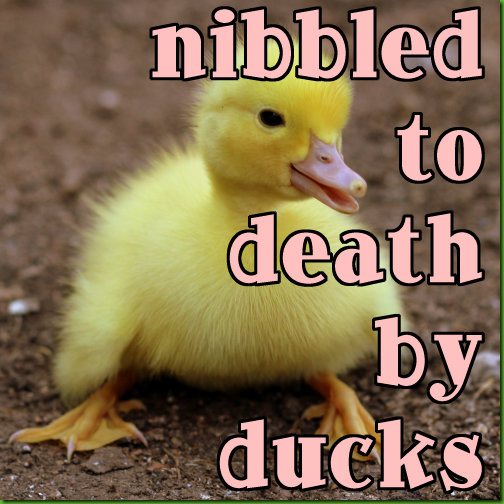
But really, a better image is ducks.  This guy:

image

There’s an expression I hadn’t heard before a few years ago, and it sums up my strategy for getting this book DONE, and that is:  "Nibbled to death by ducks." 

What does it mean?  Well, look at that duck.  He's pretty cute, right?  That beak totally doesn’t mean business.  He looks like a lightweight for sure.  If you let him nibble at you, he wouldn’t do much damage.  Unless he kept nibbling.  Just kept nibbling and nibbling and nibbling…

Well, okay, that’s getting a little gross.  My point being, one nibble by one duck doesn’t do much damage, but

Monday, May 15, 2017

Becoming a writer: Why knowing your strengths and weaknesses MATTERS

image

Are you feeling discouraged and thinking of giving up?  Or maybe you’re thinking about writing something but you just can’t get started?  Maybe you figure it won’t come out right – so why even bother.  Does any of that sound like you?

Maybe you just don’t know what you’re good at.

I talk a lot on this site about not just writing a book (just one book?) but about becoming a writer – looking at writing as a career (even if you already have a career!).  And part of becoming a writer is figuring out what you’re great at doing… and what doesn’t come so easily for you.

I think I’m good at writing – but when it comes to marketing, which is a big part of being a writer today (like it or not), I don’t think that’s one of my strengths.  What about you?

What are you super-good at?  I bet you know already, but maybe you haven’t spent enough time basking in it.  This could be something you’ve heard from a whole bunch of people.  Maybe you’re secretly proud but don’t want to seem like you’re gloating.

Take the time to enjoy your strengths.  In the table below, you’ll find a bunch of different writing tasks and you’ll have a chance to see exactly how many things you are probably quite good at doing.

Unfortunately, unlike in many careers, you can’t just work on a sub-specialty and ignore the rest.  You will eventually have to deal with everything I’ve listed in the table below – and then some.  But there are some very good reasons to go into writing with your eyes open – with a keen awareness of your own strengths and weaknesses.

Why figure out your strengths?

Identifying your strengths makes you feel good about yourself!  I’m not big into self-esteem just for self-esteem’s sake.  But if you genuinely ARE good at something, you deserve

Thursday, May 4, 2017

Be grateful for editors!

image

Yesterday, I got the phone call I was dreading – a call from my EDITOR.  I spent half an hour on the phone yesterday with the person in charge of editing my next children’s book, and I have to admit, I had been dreading her call for a while.

I got an email from her when the book was first accepted by the publisher (yay – details to come, I promise!) saying, basically, “We love your book, but naturally, we’re going to have to make some changes to the text.”  Which is their prerogative, right?  I can’t force them to publish my book as-is, no matter how much I love the text, so my best bet if I want to be published is to roll with things.

So.  I was prepared to roll with things.  But that doesn’t mean I was looking forward to her call, in which we would “discuss the changes.”

Ugh.  Did she not realize how much I’d sweated over every single word of that story?  Written, revised, erased, gotten it to the point where it was just about perfect?

Let me tell you – I didn’t feel particularly grateful about the spectre of her call.

When you read a commercially-published book, you’ll often see a bit at the beginning or the end where the author thanks her family, her agent, and then her editor (or editors).  I always took that part for granted until I started working as a novice journalist and working with editors who actually hacked and slashed and carved up my writing to find the most important points within it and bring those to the fore. 

And at first, dealing with those editors, what I felt was mostly ingratitude.  How dare they tell me how to write?  Isn’t writing supposed to be an art form?  And if so, would they swipe their red pens across a Degas or Van Gogh if they didn’t like what they saw on the canvas?

I was being – feel free to slap me now – frankly ridiculous.

Oh, I was gracious enough.  I wanted to keep making money and getting published, so I rolled with it, like I said, and even said “thank you.”  But I wasn’t feeling it.  Oh, boy, was I not.

But gradually,

Sunday, February 5, 2017

From Manuscript to Commercially-Published Book in 12 VERY Easy Steps

image

Have you ever asked the question – if I self-publish, does that mean I’m stuck self-publishing forever?

A lot of writers think they’re stuck defining themselves as one or the other, either a “self-published writer” or a “commercially-published writer.”  I hope you haven’t fallen into that trap!

In fact, you don’t have to pigeonhole yourself that way, as I hope I’ve proved with the release of my first book from a commercial publishing company, Yossi & the Monkeys (Kar-Ben, 2017).

So what’s it like having a book commercially published after so much self-publishing experience?

It’s weird, that’s all I can say.  It’s all about sitting back, relaxing, and WAITING, because this thing took – well, forever.

But still – I thought it would be fun to break it into steps, like in my last post, so you can see what was involved along the way.  So here we go… with Step 1.

Step 1.  Contest submission.

It all started back in 2014 with a Jewish kids’ story contest at Barbara Krasner’s website.  I entered, didn’t win, didn’t even come close.  But a real editor was reading!

Trouble was, my story came in at around 10,000 words (what was I thinking???).  It had 10 chapters, it was an EPIC.  Oops… wayyyyy too long!  Here’s Chapter One.

image

2. Contest rejection

Well, needless to say, this 10,000-word behemoth was rejected – with just about the nicest rejection note I have ever, ever seen:

image

She liked it!  She really did!  Considering I hadn’t paid anything to enter this contest, it was a delight to receive a positive reply like this.

Only trouble was… how to get the story down THAT small?  10,000 words to 850 words???

From Manuscript to Self-Published Book in 10 Simple Steps

image

What’s next? 

That’s the question I hear most often from writers out there.  Maybe even from you.  It’s what everybody wants to know, so if you’re stuck on that question, you’re not alone.

You already have a great story, one you really believe in, and you’re READY – you just want to get your story out there into the world.

Here’s the great news:  you CAN!

You can self-publish your book, in ten not-so-tough steps I’ll lay out for you here.  You’ll have to put in some time, some energy, and there is absolutely a learning curve.  But I believe this process is so simple that just about anybody can master it with a little experience.

I’m going to illustrate these steps with a book that I actually did self-publish.  It’s called Shabbat Monsters.  It’s a good example because it’s a pretty classic 32-page rhyming picture book. 

Let’s get started… at the very beginning, with

Step 1.  Your MANUSCRIPT.

image

Looks pretty plain, doesn’t it?  I hope you’ve had it professionally edited.  If not, go do it – NOW.

Okay, you’re back.  Your story’s ready.  Let’s move on to…

Step 2. Your dummy

No, I’m not CALLING you a dummy!  It’s time to make a dummy.  32 pages, 2-page spreads.  Time to start planning what we (the reader) are going to see on every single page.

imageimageimage

So that’s the first stage of planning what the pages are going to look like.  Once I know what illustrations I’m going to need, it’s time for…

Step 3.  Artwork

If you’re not an artist (you’ll know if you are), I strongly recommend you get a professional to do this step, even if you have to pay them.  I loved the artist I worked with for this book.  A little slow, but she was very responsive.  First, she sent me sketches…

image

Sunday, April 26, 2015

How to be a bolder, more confident writer (hint: don’t baby your book!)

image

Once upon a time (don’t worry; this is a true story), when my older kids were little, my dad took them out to the park.  I came along after a while and saw he was pushing my son alarmingly high on the swing. 

“Daddy,” I said, completely on edge, “that’s WAY too high.”

“That’s okay,” he said.  “You can always make more.”

In that moment, a) I knew he was going to ruin my son’s life by pushing him too high, and b) my father knew it was perfectly safe and I was being a silly first-time mom (albeit one with two kids, but it was still early days).

(The fact that I did indeed go on to make two more kids is irrelevant.  My father knew nothing bad would happen.)

That’s how it is with your first book, too.

Getting over the apprehension

You need to get over it.  Just as I did with my new-mom apprehension.

When I put out my first children’s book, I really cared about every aspect of it.  I laid it out as well as I knew how at the time.  I threw myself entirely into editing and the cover.  (Those things are as it should be.  I hope you do them as well.)

But

Monday, February 9, 2015

Is your manuscript headed for the shredder? 15 formatting DO’s and DON’Ts to make editors fall in love.

image

Will your story survive the slushpile… only to end up in an editor’s recycle bin, trash can, or shredder?

A story manuscript that doesn’t look like a manuscript will get you exactly the WRONG kind of attention.  The kind that winds your story up in that virtual paper shredder before the editor gets to word one.

True, you’re submitting a children’s book.  But the core of all these DON’Ts is one simple fact:  your story can’t LOOK like a children’s book when you submit it.

What not to do.

Be very, very careful.  Violating any one of these will get your story tossed (or shredded) in disgust:

    Wednesday, January 21, 2015

    Fed up with Kindle Kids’ Book Creator? Try this free, easy 5-step alternative.

    image

    Scared to try doing Kindle books because you’re no techie?  Or have you decided that the Kindle Kids’ Book Creator isn’t the software for you (Here are 5 reasons why it isn’t.) but don’t know what to use instead? 

    Relax.

    Seriously, there is an alternative.  And it’s easy, free, and doesn’t need much more than a working knowledge of Microsoft Word.  It may even be easier than the KDP Kids’ Book Creator software itself.  (Besides being waaaay more flexible.)

    These days, for many of my ebooks, I’m using two simple tools:  Microsoft Word and a free ebook conversion program called Calibre. 

    I’ve been using Calibre for years and never realized it could not only open and save ebooks but also help create them.

    NOTE:  I’m talking about picture books here.  For longer-format and nonfiction ebooks, you should probably do them entirely in Scrivener ($40, Literature & Latte).  (Here’s a post about how I use Scrivener.)

    I’m going to walk you through my process, in 5 steps I think you can handle and maybe actually enjoy, with a little practice.

    Thursday, June 12, 2014

    Grab the ladder: climbing your way to a self-published children’s book.

    image

    Have you written your story already, but have no idea what comes next?  Everybody says the sky’s the limit, but what if that sky looks impossibly out of reach… and you’re scared of heights?

    The first time I published my own kids’ book, I had no idea of what to do when.  What steps came first, and which could wait until later.  And I made a lot of mistakes.  The layout looked funny, I ordered black-and-white instead of colour, forgot to put in the copyright information at the beginning.

    I made those mistakes because I couldn’t find a a ladder:  a guide that told me what to do when, or at least, gave me some idea of what needed to be done to reach the top.

    That’s why I’m so excited about sharing my process.  This is an evolving process; with every book I do, it generally gets easier, now that the basics are familiar.

    That will happen for you, too.  The first time is always an adventure; sometimes a scary one.  And while each book is a new ladder to climb, you’ll be able to climb to the top a little easier each time.

    Monday, May 26, 2014

    Self-publishing? Why you MUST proof a hard copy of your book!

    children's books by Jennifer Tzivia MacLeod

    Such a rush to hold your book in your hands.  It’s ready!  Or is it???  These books all look great – right?  Maybe from the outside.  On the inside, there’s serious work to be done.  And you can’t, can’t, can’t do it all on your screen or online.

    On-screen proofing is not the answer

    That’s a shame, because at least it you’re self-publishing with CreateSpace, Lulu, the two most popular self-publishing sites, they make it super-easy to upload your book’s interior and check everything online.

    Createspace even offers a “Digital Proofer”… doesn’t that sound like a cool alternative to paying for a proof copy plus delivery, and then waiting the weeks and weeks (and weeks!) for delivery???  (We live in Israel; your shipping time may be less if you live closer to what Createspace considers the real world.)

    Just say NO!  To online proofing.  Well, you don’t have to say no… it can be a valuable tool to find simple problems.  But don’t use it as a substitute for actual proofing, with a hard copy.

    Self-publishing? Why you MUST proof a hard copy of your book!

    Having learned from experience, I now order a hard-copy proof every single time.  These three new books all arrived yesterday:  Penguin Rosh Hashana, Yossi and the Monkeys, and Baby!  Life before birth.

    Why would you need a hard copy if you check it all very carefully on the screen?

    Wednesday, April 30, 2014

    Four signs you’re not cut out for self-publishing… and one reason you might be after all.

    success-259710_1920 Self-publishing used to be for losers.  It wasn’t even called self-publishing – it was called “vanity publishing.”  Even the name meant you were a loser:  “You’re so vain… you prob’ly think this book is about you!” 

    In between staring at the mirror and primping your nails, you wrote a book; how cute!

    Who’s a loser now?

    That “loser” reputation was well-earned in some cases.  Companies out to “help” writers publish their books would sell exorbitantly-priced packages of legitimate-sounding “services,” from editing and illustration to layout and promotion.  But mainly what they’d “serve” you with, often for thousands of dollars, was a useless box of poor-quality books that would sit in your living room for years, doing nothing to sell themselves.

    (A few of these companies have “successfully” transitioned to the Internet.  Visit the Writer Beware blog for a guide to some of the more heinous among them.)

    That is NOT today’s self-publishing environment.  Today, self-published books are of great quality.  They look and feel super-professional, and they’re cheaper than ever.  For under $10, including delivery, you could be holding your finished children’s book in your hands next week.

    Why self-publishing may not work for you

    So there’s no shame in self-publishing anymore.  But that still doesn’t mean it’s for everybody.  Here are four signs that self-publishing, even in today’s easy-entry market, might not work out for you.

    Thursday, April 3, 2014

    Deconstructing the story: Mini-Interview with Writer/Illustrator Rinat Hoffer

    image

    Rinat Hoffer is probably the most popular and perhaps prolific children’s-book author in Israel today. But for me and my kids, she’s something more – a friendly, fun bridge to Israeli culture and life in this strange, busy, modern country.

    We first “met” her books back in Canada at our local public library. I can’t tell you how long it would take me to pick books from their Hebrew books shelf.

    Before continuing, I just want to show you what MOST of the Hebrew kids’ books that I found looked like inside:

    clip_image006

    Yes, they really were this bad.  And this is one of the good ones.  I mean, the bunny and girl are kind of cute.  It’s just dated, with little sense of design and overly dense text.

    The language inside (and these are kids’ books, not War and Peace!) was almost as incomprehensible to me as it is to you (unless you’re fluent, in which case, skip to the end – there’s a video). And the art… well, growing up with many of the classics of modern kidlit, something was definitely lacking.

    Even back in Canada, Rinat helped change my mind completely.