Tuesday, July 15, 2014

Basics, Part 3: Are you choosing words that zoom, screech, soar, sing?

image

You’re a writer, right?

And writing is all about words? 

(Come on, let me hear you nodding.)

So picking the words to go into your kids’ book should be simple… but it’s not.

In the first post in this series, Basics, Part 1: What is a children’s book? I laid out the most simple definition of a children’s book: 

  1. Pages between covers
  2. Aimed at young readers
  3. Usually illustrated
  4. All about story

In Basics, Part 2: Does your book measure up?, we looked at the first part of that definition:  pages between covers.  How many pages, exactly?  How many words?  Well, that depends on who you’re writing for.

And so does the language you choose to fill your book.

You want to choose words that zoom; words that soar; words that transport your readers and sing to them – or screech at them.

In Part 2, I actually gave you a chart, and I’m going to do the same thing here. 

Let me be honest:  a lot of people HATED the chart in my last Basics post.  These folks are artists, and I respect that.  And they refuse to be hemmed in by conventions.  Fair enough.

Life as an artist

But if you were an artist artist, I mean the kind that paints pictures, and somebody hired you to paint a family portrait to hang on the wall above their fireplace… would you measure the wall above their fireplace first?

I suspect you would.

And then you’d choose a canvas to fit the space, right?

(Just keep nodding.)

Here’s what you wouldn’t do:  go home, picking up any old size of bedsheet along the way; and proceed to paint the picture on a canvas that was huge… or too tiny to be seen.  If you do, I would hope you’d have the good grace not to get made at your client if he refused to pay for your work.

As most painters through the ages have discovered, working within size (and other) constraints probably won’t kill your artistic spirit.

So please don’t hate me for suggesting them.

Big, beautiful words

Wednesday, July 9, 2014

Christian without the Cringe: 5 ways to craft stories with spirit

image

Are you Christian? 

If so, you’re right up there with 76% of Americans who believe in some form of Christianity

But I’m not.

Our family is Jewish, and I’ve written about writing Jewish children’s books a few times before.  I thought it would be both fun and fair to my non-Jewish readers to offer a bit of breadth and invite a friend to talk about her approach to writing Christian children’s literature.

Polls show that more than 90% of Americans believe in God. 

They may not all be deeply devout, but many are, and that means hundreds of thousands of parents looking for books that reflect their own family’s values.

This is a major market.

I’m not deeply sad that I don’t get a slice of this pie, but I’m happy to be able to share her tips to help you reach these families, if that’s part of your writing goal.  With these 5 tips, I hoped to help you turn out books that are Christian without the “cringe” factor. 

You know what I’m talking about, right?

But then I read her post, and realized it wasn’t just for Christian writers. The rest of us need to read this, too.

Monday, July 7, 2014

5 People You Need on Your Team When You’re Self-publishing a Kids’ Book. (guest post)

image

Greetings from a harmless ghost,
And please don’t miss today’s great post
It isn't here, but
over there,
A guest-post I just had to share.

It's all about the team it takes
To make your book amazing shakes.
So click right through and check it out,
And leave your comments thereabout.

I’ve loved Joel Friedlander’s Book Designer blog and have wanted to guest-post there for a while… so I did, with this post, 5 People You Need on Your Team When You’re Self-publishing a Kids’ Book.

Hope you’ll stop by over there to check it out.

Sunday, July 6, 2014

Idea theft: how safe is your story?

image

“That’s MINE!”

You can hear the cry in probably every kindergarten in the world… and perhaps every gathering of writers, as well.

Oh, we don’t shout it out loud.  But we THINK it, huddling protectively over our story ideas as though someone was going to steal them if we let them out of our sight for a second.

Well, I hate to break it to you:  you can’t copyright an idea.  You also can’t copyright your book’s title.  The only thing that’s protected by copyright is the story you write – the whole exact story.  (Here’s more on copyright and book titles, if you’re interested.)

But the happy flipside of that is that theft is really rare in the world of children’s writers.  So you can comfortably chat about your story ideas, your titles, or anything else.  Your ideas won’t be stolen, for instance, if you …

  • workshop them in a class or course
  • submit them to a mainstream publishing company
  • talk about them at a party
  • work on them on a laptop over a public network, like a coffee shop

Most writers actually have one of two main concerns when it comes to story theft: 

Friday, July 4, 2014

Busting out of your niche: mini-interview with writer Eric A. Kimmel

image

Creepy.

Sorry, but that’s what comes to my mind when I think of Eric Kimmel. 

Creepy, as in the very best kind of creepy Jewish books:  ghosts, ghouls, goblins and all things paranormal. 

Hershel and the Hanukkah Goblins kind of creepy.

Gershon’s Monster kind of creepy. 

Jack and the Giant Barbecue kind of creepy.

Huh?  Jack and the… giant… barbecue?

Check it out:

image

Sure, Eric is the undisputed champion of creepy Jewish kidlit, but if that sounds like he’s stuck in a niche, think again.  He’s not just about creepy… or just about Jewish books, as you’ll see. 

Monday, June 30, 2014

Stuck in the middle? 6 cheats to get you out of your bind.

3779719335_b1a8745502_z

We’ve all been there.

You start a story, typing furiously in an attempt to get the words down as quickly as they are flashing through your mind. Then your fingers come to a screeching halt. Staring at the screen, you are stuck in the middle of the story wondering what happened to that inspiration. Get it back.

Here are 6 “cheats” that can pull you out of the glue when all you see is stuck.

Sunday, June 29, 2014

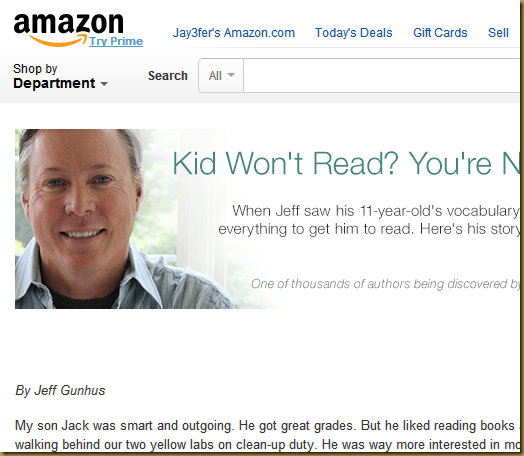
Who’s Jeff Gunhus and what makes him a self-publishing success story? (a mini-interview)

image

How did I find out about Jeff?

Well, his self-publishing success story was featured a couple of weeks ago on Amazon’s home page.  And when a self-publishing kids’-book author is highlighted right up there in lights, I sit up and pay attention.

You’ll be happy I did.

It turns out that his Jack Templar Monster Hunter series of kids’ books aren’t the only self-publishing Jeff has done. 

In fact, two of his novels have brought his AuthorRank up to #52 in Kindle eBooks for Horror, a very crowded genre (to give you some idea of who he’s up against, Stephen King is at #1). 

image Look, the numbers in self-publishing are scary.  So, although it might not seem like an accomplishment that his adult book Night Chill is currently Amazon-ranked #25291, it’s a lot more impressive when you realize he’s up against basically every book in the world.

That’s why we need to pay attention to what Jeff’s doing right.  Jeff’s done two things (at least) to set himself apart from the crowd:

Wednesday, June 25, 2014

Writing with Pride: creating LGBTQ kids' books that don't make it an "issue."


Are you proud of who you are?

I hope so.

But as much as I wish I could say that pride was enough to create a great kids' book... it's not.  The last few years have seen a flood of LGBTQ-oriented kids' books rushed into print... not all of which are fantastic.

I want to say this up-front:  I am not LGBTQ, and I write this as a white woman married to a white man.  So some would say that we're uniquely privileged... and that members of a minority should take any opportunity they can get to show families like theirs.

I don't want to argue with that.  I want to believe, instead, that there's a way to do that that doesn't undermine the cause.  And that way is to write a great story, with characters that happen to be... well, whatever type of characters you want to depict.

Why pride isn't enough

Too many of these books, particularly the classic ones, focus on the central "issue" - that there are two mommies, two daddies, that somebody is transgendered, whatever it is.  And those kinds of books are not only generally tedious to read, but also don't appeal to children.

      
I have a mom and a mom... or a dad and a dad!

The message of these stories is usually pretty simple-minded:  yes, we're different, but we're happy and our lives are full of love.  It's certainly not an offensive message....but neither is it very interesting, or engaging to a child.

I wear a dress, even though I'm a boy!

Children, by nature, take most situations at face value.  It's us grown-ups who have trouble processing things that are new or different.  If a kid has two mommies, she knows it and doesn't usually love it or hate it - it just IS.  If somebody at school has a problem with that (probably not another kid; probably one of us closed-minded grown-ups), there are ways of reassuring kids without making a big deal out of it.

Another thing about "issues" books?  They get dated REALLY fast.

Books centred around the theme of overcoming intolerance and educating the general public are going to seem very, very odd in a decade or two when it's just Not a Thing (as my 18-year-old daughter would say).

Want to know the worst offense when it comes to "issues" books?

Thursday, June 19, 2014

Basics, Part 2: Does your book measure up?

image

How long is a children’s book?

Figuring out how long your kids’ book should be is easy:  you start typing at the beginning, and stop when it’s long enough.  Or do you?

In the first post in this series, Basics, Part 1: What is a children’s book? we looked at the most simple definition of a children’s book: 

  1. Pages between covers
  2. Aimed at young readers
  3. Usually illustrated
  4. All about story

I’ve talked a lot over the last little while about points 2-4, but not so much about #1, namely – how many pages should be between your covers?

I’ll tell you in a second.  In fact, I’ll go one better and give you a handy chart.

But first – I want you to remember that word lengths and all this technical stuff has NOTHING whatsoever to do with #4, “all about story.”  Your children’s book is primarily about story, and when you’re writing your first draft, just write. Don’t even think about word length.

Monday, June 16, 2014

Seven “story renovations” that will make your book great.

image

You know what breaks my heart?  When I hand my story to a reader (an honest proofreader, please!)… and they read the story. 

Here I am, and I I love the story, so I’m all, like, “well?  well?” … and they say, “I liked it.”  That “like” breaks my heart.  That is the “like” that is not love… it means my story’s not good enough.

Has that ever happened to you?

Sometimes, little changes aren’t enough to bridge that disconnect between the story unfolding beautifully in my mind and the story on paper that will make readers say “wow.”  That means your book (and mine) needs a big change.

Don’t be afraid to overhaul your book.  If they can pull up scaffolding and repaint the Sistine Chapel, surely you can take a pen – or keyboard – to your story and have it, too, emerge renewed, recharged and more brilliant than ever.

Here are seven big changes that can take almost any story and make it stronger.  Save your first draft so you can come back to it if you need to… and then plunge right in to make your story better and stronger than ever.

1. Who’s the main character?

This one may be the scariest change to make.  At one point, I was working on a story with a child as the main character, except I was stuck with the story… until my teacher suggested making the main character an adult instead. 

Sunday, June 15, 2014

Carnival of Jewish Books – June 2014 / Sivan 5774

Read, written or reviewed a great Jewish book lately?  These bloggers have! 

Welcome to the June / Sivan Carnival of Jewish Books, a monthly roundup of all things bookish in the Jewish blog world.  I’m going to quote one of the previous hosts here: 

If you blog about Jewish books, you can play too! Visit the Jewish Book Carnival HQ for info about submitting your links to upcoming carnivals.

Let’s hop on a magic carpet and take a tour of what’s happening in Jewish book blogging this month.

Saturday, June 14, 2014

TOBY Book Launch Blog Tour: mini-interview with author Stacy Nyikos

image

If you’re here for the book tour, come on in, make yourself at home… and come meet Stacy Nyikos, a writer who says she’s “hooked” on writing kids’ stories.

imageAs a children's writer, I get to create worlds as spongy and delicious as marshmallows, soar through green oceans with talking sharks, and float on misty air currents riding the backs of ancient dragons. It's an amazing place to live in. And it changes on a daily basis.

You can see why she’s had such success so far.

Stacy’s new book, Toby, illustrated by Shawn Sisneros (Stonehorse: 2014), is about the journey of a turtle hatchling, who emerges from his egg to find himself all alone.  Where are the other turtles?  Toby’s journey gently explores the often-perilous reality facing a solitary baby sea creature, but with fun verse that really works well with Shawn’s appealing illustrations.

As you’ll see, sea creatures are a bit of an obsession for Stacy, and with very good reason.